Clara Barton at Antietam: The Angel of the Battlefield Emerges
On September 16, 1862, Clara Barton arrived in Sharpsburg, Maryland, in the vicinity of the Army of the Potomac. A battle loomed. It was here that Clara would experience what soldiers on both sides referred to as “seeing the elephant”; a first time in combat. She spent the night near Ambrose Burnside’s 9th Corp, which she had previously encountered that summer in Fredericksburg, Virginia. Reflecting on it later in an essay for the American Red Cross, she wrote:
It was a miserable night. There was a sense of impending doom. We knew, everyone knew, that two great armies of 80,000 men were lying there face to face, only waiting for dawn to begin the battle.
The Battle of Antietam raged on September 17, 1862, America’s bloodiest day with more than 23,000 casualties. The 24-acre cornfield on David Miller’s farm was a point of significant carnage.
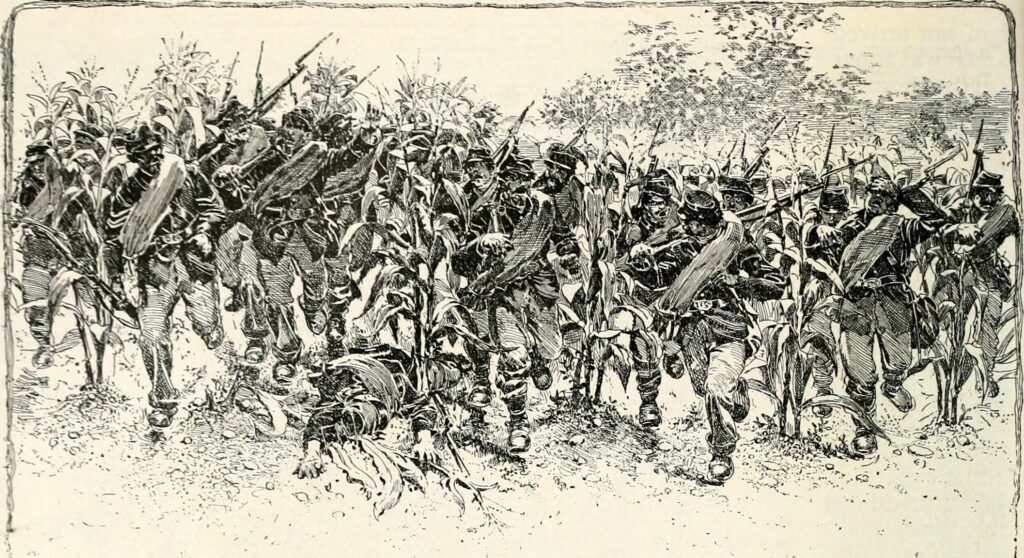
Federal Soldiers in Miller’s Cornfield (Indiana State Library)
Clara heard the first shots well before the sun was up. Soon the full roars of battle sounded closer and louder than she’d ever heard them before. After waiting for daylight, she realized the fighting was at the opposite end of the line. She charted her route on a map and navigated military traffic, arriving at Samuel Poffenberger’s farm around 9:00 a.m. Casualties from Miller’s Cornfield were pouring in and supplies to treat them were scarce; cornstalks were being repurposed as bandages. Smoke and bullets from the nearby cornfield filled the air and the farm was in range of rebel artillery. If Clara had simply delivered her wagon’s lifesaving provisions under fire and left for safety she would have been a hero. But she courageously remained in the thick of the action; her day was just beginning.
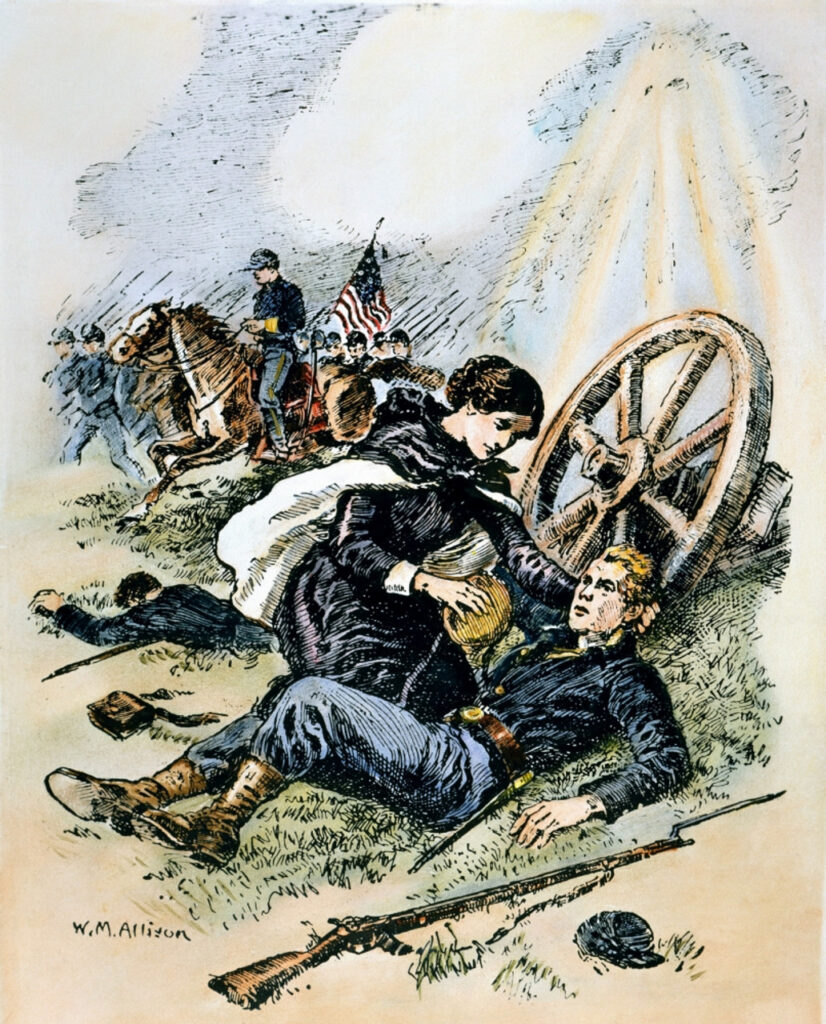
Through the Weary Years of the War Clara Barton Stayed at Her Post (Library of Congress)
For the next 36 straight hours, she labored in some of the worst conditions imaginable. She worked primarily at Samuel Poffenberger’s farm but was spotted at hospitals across the battlefield including Joseph Poffenberger’s farm, the Pry farm, the Middle Bridge, south of Sharpsburg township, and in the vicinity of Pleasant Valley. Despite having no official job title, she served nearly as a quartermaster, aid, nurse, and cook. Every time circumstances called for her to perform these duties, she answered. Under duress, she cut a bullet out from a suffering man’s cheek wound with a pocketknife. She held another wounded man in her arms and as she helped him take a drink of water from a canteen, a bullet passed through her dress sleeve killing her patient instantly. When artillery fire began to burst overhead she helped carry wounded mento cover in a barn, shed, or corn crib. When she heard army rations had been exhausted, she made the soldiers gruel. That night she retrieved the candles and lanterns she brought which the surgeons lacked so that lifesaving procedures could continue after dark.
After volunteers from civilian relief agencies arrived with their own stores and army supply lines had been fully restored, Clara felt ready to go. She was also ill herself with typhoid fever. She returned to Washington, D.C. to recover, which turned out to be a long road back to health. She wouldn’t be back on her feet again until early October.
Clara had not gone to the front to seek fame. She went simply because she knew her country needed her. She stayed because what she saw confirmed it, and despite the danger as well as her failing health she did not leave until she felt her part had been played. But well-earned notoriety and acclaim soon came. Surgeon James Dunn, who by chance had also been aided by Clara at Culpeper and Fairfax Station, sent a letter to his wife with the intent to have it published in newspapers. He wrote:
Our soldiers had no time to rest after reaching Washington, but were ordered to Maryland by forced marches. Several days of hard marches brought us to Frederick, and the battle of South Mountain followed. The next day our army stood face to face with the whole force. The rattle of 150,000 muskets, and the fearful thunder of over 200 cannon, told us that the great battle of Antietam had commenced. I was in a hospital in the afternoon, for it was then only that the wounded began to come in.
We had expended every bandage, torn up every sheet in the house, and everything we could find, when who should drive up but our old friend Miss Barton, with a team loaded down with dressings of every kind, and everything we could ask for. She distributed her articles to the difference hospitals, worked all night making soup, all the next day and night, and when I left, four days after the battle, I left her there ministering to the wounded and the dying. When I returned to the field-hospital last week, she was still at work, supplying them with delicacies of every kind, and administering to their wants, all of which she does out of her own private fortune.
Now, what do you think of Miss Barton? In my feeble estimation, Gen. McClellan, with all his laurels, sinks into insignificance beside the true heroine of the age, the angel of the battlefield.
Henceforth, as Dunn’s letter and further accounts of Clara’s work circulated, she would be known as “the Angel of the Battlefield.”
About the Author
Roy Blumenfeld is a history enthusiast and volunteer docent at the Clara Barton Missing Soldiers Office Museum. He holds a BS in Political Science from Appalachian State University.
Sources
Websites
- “Notes on Antietam.” National Park Service, U.S. Department of the Interior, 2017, www.nps.gov/clba/learn/historyculture/antietam.htm
- “Clara Barton Papers: Speeches and Writings File, 1849-1947; Speeches and lectures; War lectures, 1860s” Library of Congress. https://www.loc.gov/resource/mss11973.107_0270_0490/?st=gallery&c=160
- Sandy, Lewis, MD. “Follow the Cannons: Clara Barton’s Pioneering Battlefield Nursing at Antietam.” AJN Off the Charts, ajnoffthecharts.com/follow-the-cannons-clara-bartons-pioneering-battlefield-nursing-at-antietam/
Books
- Oates, Stephen B. Woman of Valor: Clara Barton and the Civil War. Kent State University Press, 1996.
- Kerr, Paul B. Civil War Surgeon Biography of James Langstaff Dunn, MD. AuthorHouse, 2012.
- Weller, David. The Cornfield. Casemate, 2022.
- Dammann, Gordon, and John W. Schildt. Islands of Mercy. E. Graphics, 2019.
- Woodard, Scott C., George C. Wunderlich, and Wayne R. Austerman. Combat Readiness Through Medicine at the Battle of Antietam. Borden Institute US Army Medical Center Of Excellence, 2022.