Clara Barton at Fairfax Station
In the late summer months of 1862, the small hamlet of Fairfax Station, Virginia, was temporarily flooded with thousands of wounded soldiers brought from two nearby battles, The Second Battle of Manassas, fought August 28-30, 1862, and the Battle of Chantilly on September 1, 1862. Clara Barton, in her steadfast determination to render aid, was among the noble volunteers on hand to care for them.
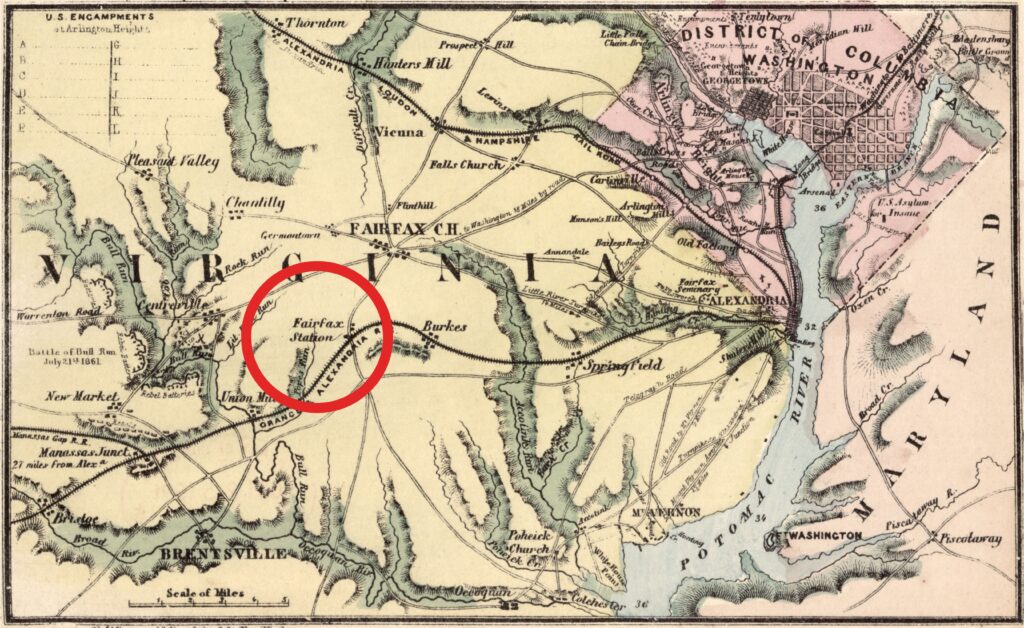
Topographical Map of Virginia Between Washington and Manassas Junction (Library of Congress)
Clara had received permission in July 1862 to travel with the federal Army of Virginia. Her first battlefield experience came at Culpeper, Virginia in the aftermath of the Battle of Cedar Mountain. She distributed hundreds of pounds of supplies which she personally had amassed and nursed the wounded who severely overwhelmed surgeons and doctors couldn’t care for alone. Following her time in the city’s hospitals from August 13-15, 1862 she returned to Washington and monitored the news from the Army of Virginia’s continued campaign.
The Second Battle of Manassas, known in the north as the Second Battle of Bull Run, would be a costly one for the Union, with more than 14,000 casualties, nearly 8,500 of these wounded men.
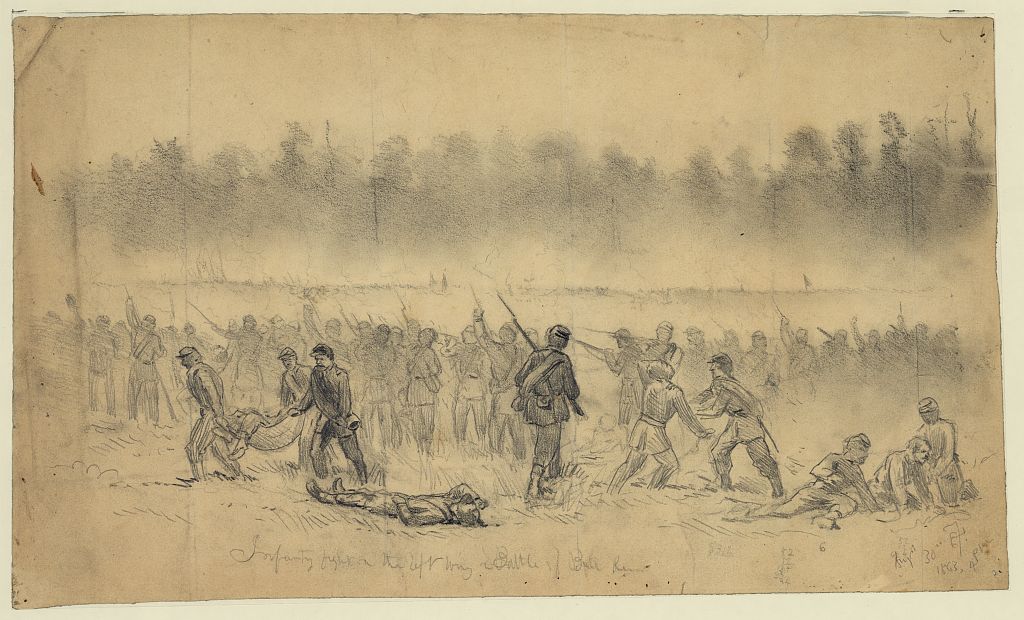
Evacuating the wounded at The Second Battle of Manassas (Library of Congress)
The Union Commander General John Pope issued an order for the wounded to be brought to Fairfax Station where the tracks back to Alexandria were still intact and relatively secure. From August 30 until September 2, 1862, a sporadic stream of wagons and ox carts arrived full of wounded soldiers. The town’s St. Mary’s Church and the train station were commandeered and surgeries for the most severe cases were performed inside the church. The church pews were brought outside to accommodate some of the wounded as they waited for surgery, but most of the suffering men lay in the elements, enduring heat and rain.

Fairfax Station photographed during the Civil War by Mathew Brady and his assistants (National Archives)
The War Department desperately needed volunteers to assist with the unfolding crisis at Fairfax Station, and Clara, now experienced in frontline nursing heeded the call. She knew the danger she was putting herself in; federal forces were actively retreating away from the area and the railroad she was set to travel on had become a target for the Confederates. Before boarding a train to Alexandria to gather badly needed supplies, Clara wrote a note to her friend Mary Norton stating “if by any chance I should not return, you will know where I went at least.” She penned a longer letter to family in Massachusetts:
August 31, 1862
Dear Brother and Sister
I leave immediately for the Battlefield, don’t know when I can return.
If anything happens [to] me,you David must come and take all my effects home with you and Julia will know how to dispose of them.
Love to all,
Your affect. Sister
Clara
When she detrained that August afternoon, she encountered masses of suffering men, as far as the eye could see. She went man to man doing all she could. As they cried out for relief from hunger, thirst, and pain, Clara fed them and helped them drink. Among the wounded, she found her old childhood school friend Charley Hamilton badly mangled. Clara bravely labored with other volunteers to provide care as the wounded were loaded onto trains back to Alexandria.
An unforgettable heartbreak occurred that evening, one that Clara would retell later in her life. A young New York soldier named Hugh Johnson lay dying in agony a short way away from the other wounded. He had collapsed and been left for dead. In the dark, he cried out for his sister Mary. At the urging of other wounded men Clara went out to comfort him. She held him in her arms as he fell asleep. He woke the following morning with a renewed will to live. Clara secured him a spot on the next train to Alexandria. Hugh lived long enough to be reunited with his family, including Mary, but passed away a short time later at Armory Square Hospital in Washington, D.C.

General Phil Kearny’s gallant charge at the Battle of Chantilly (Library of Congress)
On September 1, 1862, a smaller but vicious battle was fought north of Fairfax Station in Chantilly, Va., and 1,300 more federal soldiers, including Major Generals Issac Stevens and Phil Kearny, became casualties in the rearguard action. Kearny’s former comrade turned adversary Confederate General A.P. Hill told his men “You’ve killed Phil Kearny[;] he deserved a better fate than to die in the mud.” Soon thereafter, these wounded streamed in and joined with the others.
The last day of the Fairfax Station field hospital’s existence, September 2, 1862, was full of drama and tension. Almost all of the Army of Virginia and the Army of the Potomac had withdrawn into Washington’s defenses. It was now a race to evacuate the remaining wounded before Confederate troops arrived. The body of Maj. Gen. Kearny arrived under a flag of truce. It was accepted by a complement of his men and loaded onto a hospital train. Later, Confederate sharpshooters fired off a few shots at the hospital. A federal officer appeared on horseback to warn Clara she may need to borrow his mount to escape if the railroad got cut off. Clara, the doctors, additional volunteers, and the remaining wounded boarded the last train to Alexandria. The station had been set ablaze to prevent it from being utilized by the enemy. As they pulled out of the area, Confederate cavalry skirmishers arrived. Most importantly, the wounded had been saved.
When Clara Barton arrived home at the boarding house on 7th Street, she slept for 24 hours straight. Upon waking, she called on the wounded in Washington D.C.’s hospitals and pondered where the war effort may need her next.
Learn more about Clara’s role at Fairfax Station from the Fairfax Station Railroad Museum.
About the Author
Roy Blumenfeld is a history lover and volunteer docent at the Clara Barton Missing Soldiers Office Museum.
Sources
Websites
- “Second Manassas.” American Battlefield Trust.https://www.battlefields.org/learn/civil-war/battles/second-manassas
- “Chantilly.” American Battlefield Trust. https://www.battlefields.org/learn/civil-war/battles/chantilly
- “St Mary of Sorrows Pre-Civil War Beginnings Into the 21st Century” St. Mary of Sorrows. https://stmaryofsorrows.org/?page_id=1346
- Berg, Gordon. “This Union General Had It All: Wealth. Women. One Arm. He Died at 47, Refusing to Surrender.” HistoryNet, 2022. https://www.historynet.com/phil-kearny-ox-hill-battle/
- “Clara Barton Papers: Family Papers: Barton, David and Julia Porter (brother), 1850-1883” Library of Congress. https://www.loc.gov/resource/mss11973.007_0162_0210/?sp=13&r=-0.247,-0.873,1.544,2.435,0
- “Fairfax Station” Historical Marker Database. https://www.hmdb.org/m.asp?m=885
Books
- Oates, Stephen B. Woman of Valor: Clara Barton and the Civil War. Kent State University Press, 1996.