In the Line of Fire: Clara Barton at Cedar Mountain
On August 9, 1862, in Culpeper County, Va., Union General Nathaniel P. Banks’ corps clashed with Confederate forces under General Thomas “Stonewall” Jackson. Initially, Union troops gained the upper hand, pushing back Jackson’s men, but a Confederate counterattack, reinforced by A.P. Hill’s division, turned the tide. The Union line collapsed, retreating toward Culpeper. The battle left more than 3,600 casualties and confirmed Confederate control of the region, setting the stage for the Second Battle of Manassas later that month. Cedar Mountain showcased Jackson’s aggressive command style and left more than 2,300 Federal casualties on the field and more than 1,300 Confederate.
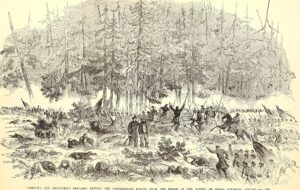
The Battle of Cedar Mountain, August 9, 1862. (“Frank Leslie’s Illustrated History of the Civil War”)
Clara Barton had not been on the field during the fighting. In fact, she didn’t arrive in Culpeper until four days after the battle on August 13th. Although she had intended to be where the fighting was as soon as possible, it took her several days to get to the battlefield, a day to obtain a new pass in Washington, D.C., for Culpeper, and half a day by military train to arrive with her supplies. Despite the delay, there was still plenty of work for her to do and a dire need for the supplies she brought.
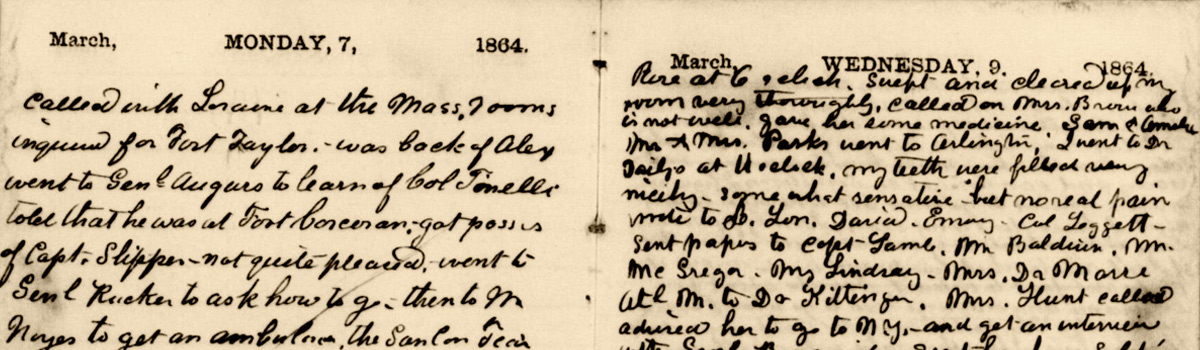
In her diary she wrote:
Thursday, August 14, 1862
Went to Main St Hospital, and found much suffering, cannot describe it P.M. Burnside came, sent for Gardner. He came and staid all night. Saw Dr. Cutter
Culpeper was transformed into a hospital. The train station, courthouse, businesses, churches, and numerous homes were all full of wounded men. There were additional tents set up outside. The military surgeons and hospital aids were stretched thin. Dr. James Dunn of 109th Pennsylvania wrote his wife on August 15:
If you had seen me you would have thought me anything else than the fancy military doctor you might expect. With that old red shirt, pantaloons and boots constituting my equipment, sleeves rolled up, and covered with blood from head to foot. I think I would have made a splendid figure for an artist.
I worked twenty-four hours in this way, doing the hardest work I ever did in my life, without anything to eat and some of the time without anything to drink, for the springs were exhausted. The soldiers and water had to be carried for three miles.
Clara and Dunn would cross paths for the first time in Culpeper, but it would not be the last. He deeply appreciated her supplies and presence in his hospital. When they met later on the battlefield at Antietam, Dunn wrote his wife about her work delivering supplies and tending to the wounded as valiant. Clara Barton, he said, “is the true heroine of the age, the angel of the battlefield.”
The sanitary situation in Culpeper decayed into a deadly threat of infection; conditions such as “hospital gangrene” were commonplace.The overburdened surgeons and their staff didn’t have time to clean. Clara took on the threat herself by scrubbing the floors with her assistants and any additional helpers she could find. Clara spent part of August 15th tending to some captured wounded Confederates. Although she staunchly opposed their cause, their need for aid bridged the gap between them. Later, she boarded a train back to Washington with Anna Carver. They had spent only two days and two nights but made a big impact.
About the Author
Roy Blumenfeld is a history lover and volunteer docent at the Clara Barton Missing Soldiers Office Museum.
Sources
Websites
- “Clara Barton Papers: 1862” Library of Congress. https://www.loc.gov/item/mss119730006/
- “Cedar Mountain.” American Battlefield Trust, https://www.battlefields.org/learn/civil-war/battles/cedar-mountain
Books
- Oates, Stephen B. Woman of Valor: Clara Barton and the Civil War. Kent State University Press, 1996
- Kerr, Paul B. Civil War Surgeon Biography of James Langstaff Dunn, MD. AuthorHouse, 2012