The Rebel of 7th Street: The Capture and Confinement of Clara’s Confederate Neighbor
At the outbreak of the Civil War, the lives of two government workers in Washington, D.C., ran parallel. The two would share space and their lives nearly converge but they would never cross. One was a woman from Massachusetts, the headstrong daughter of an old army officer who had secured a job at the Patent Office which paid her as if she were a man. Seeing wounded soldiers from her home state detraining in Washington after being attacked during the Pratt Street Riot in Baltimore, Md., galvanized her to aid their cause. The other was a man from Baltimore, a printer in the Government Printing Office with strong secessionist convictions, who only missed participating in the mob against the soldiers back in his hometown because he had been stuck in bed due to illness. When the man, still sick and unaware he missed his first chance to fight the same federal government that employed him, set out for war the next day, his doctor remarked to the patient’s mother:
“It will either kill or cure him.”
The woman was none other than Clara Barton. But who was the man that served as her foil?

Portrait of James Williamson (“Prison Life In The Old Capitol” by James J. Williamson)
James Williamson, a Marylander by birth, moved to Washington, D.C. for work at the Government Printing Office during the antebellum years. He resided in the city with his mother, wife, and children. A Confederate sympathizer, Williamson uprooted his family to move south when the war broke out. He traveled to Richmond alone in April 1861, where he secured a printer position with the Confederate central government. He then sent for his wife and children to join him. By August 1862, in the aftermath of the battles around Richmond’s outskirts and as the impact of the blockade took its toll, Williamson decided life in Richmond was no longer suitable. Surprisingly, the Williamsons decided a return to Washington was the best thing in spite of their loyalties and the risks involved. With only a pass from Confederate authorities to travel through the lines, which forced the family to take a longer route and evade federal patrols, they managed to reenter the city without incident.
Williamson found work as a lithographer at a bookstore on the corner of Pennsylvania Avenue and 7th Street, mere blocks away from the boarding house where Clara Barton lived. However, his new arrangement would not last long. On January 31, 1863, the city’s military authorities caught up to him. Williamson was arrested at work. He revealed to the officer investigating him that he had entered the city from Richmond illicitly and had not contacted military authorities upon arrival. He sealed his fate when he defiantly declined a chance to swear a loyalty oath that would likely have resolved matters. After being marched down Pennsylvania Avenue under guard, he was taken to the Office of the Provost Marshal. Another quick round of questioning ensued as well as another refusal to take the oath. He was sent directly to Old Capitol Prison. At the prison, he was given a final opportunity to take the oath during his processing and refused it. He was subsequently taken upstairs to his new place of residence in Room 16. Williamson described his new arrangement as
“a spacious room, with one very large arch window opposite the door from which the room was entered. This window was directly over the main entrance to the building on First Street, and in by-gone days it lighted up the former Senate Chamber. In the middle of the room a huge cylinder stove formed the centerpiece, while around and against the[25] walls were twenty-one bunks or berths, arranged in three tiers, one above the other. There were a couple of pine tables, each about five feet long, with a miscellaneous collection of chairs, benches and home-made apologies for seats.”
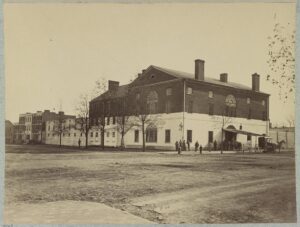
Old Capitol Prison (Library of Congress)
Old Capitol Prison was originally a tavern. For a short time after the War of 1812, it served as a makeshift Capitol. Two presidents were inaugurated there. After the Capitol was rebuilt, the building served as a school and a boarding house until 1861. When the war started, military authorities converted it into a prison complex. Originally, it was planned to hold disloyal civilians and suspected spies, but the population expanded to include rebel prisoners of war and misbehaving Federal soldiers. For a short time, self-emancipated “contrabands” who had been arrested were part of the population, too. However, the prison surgeon in charge of their care recommended, “as a sanitary measure, they should be removed to some place where they can be kept more apart from respectable white people.” Williamson alleged that occasionally detectives disguised as prisoners would be thrown into the population to gather information. The walled off facility had several wooden outbuildings, the largest two being the guard barracks and prison hospital. The prison yard was accessible for the inmates for half an hour of recreation every day. A neighboring cluster of row houses was added as an annex known as Carroll Branch Prison.

Map of the Old Capitol and Carroll Branch Prison Complex (National Archives)
Later in his captivity, due to changes at the prison, Williamson was moved to Room 10 with several other inmates. The move was less than ideal. He described it as small, close, and ill-ventilated. Unsurprisingly, under these circumstances and bad weather conditions, within days everyone in the room was sick.
The prison hospital was small but adequate. Each evening, daily sick call was taken. Any prisoner in need of care could report at that time. Vaccines were also offered to the prisoners. Williamson never went to the hospital himself, despite being sick after the move to Room 10, but wrote about an amusing incident of a whiskey-loving prisoner of war named Fitzhugh “Chew” Carter who plotted a visit to trick a hospital steward:
“Oh, I’m so sick. I got sich cramps. Bin sick all night,” said Chew, as he entered the hospital, with one hand clutching a portion of his garments covering the part of his anatomy where cramps are supposed to locate, and the other pressed against his forehead.
“I’ll give you a dose of castor oil,” said the hospital steward.
“Oh,” said Chew, “I kaint take castoh oil. Nevah could take it.”
“I’ll fix it up so you won’t taste it.”
“It’s no use, I know. You’ll hav’ter give me somethin’ else.”
The steward poured a little whiskey in the bottom of a glass; then poured in the oil, which was quite stiff, and after that put whiskey on top. Chew took the glass and with a quick toss gulped down the whiskey before the oil had fairly started to flow, and handed the glass back, saying: “Take it quick. I’m afeerd I’ll throw it up”—at the same time making such grimaces that one would think he really had swallowed a nauseous dose.
“You haven’t taken any of the oil,” said the steward. “Here; drink it down.”
“Oh, I got a big mouthful, an’ I’m pow’ful sick.”
“I’ll put some more whiskey on top. Drink it quick and you won’t taste it.”
“I did drink it jis’ ez quick ez I could. I’ll try, but I know it won’t stay down.”
Taking the glass he tossed off the whiskey from the top, as before, and leaving the oil. The steward, now seeing through the trick, said: “You can take that now as it is, for I will not put another drop of whiskey in it.”
“Well,” said Chew, as he moved toward the door, “I dun told ye I couldn’t take castoh oil. I nevah could take it. I drink’t it quick ez I could. I kin take mos’ ennything better’n castoh oil.” He came back to his room where he told of the success of his scheme to his laughing companions.
Williamson was exchanged on March 27, 1863. He decided to join the Confederate Army after being advised against another return to Washington. After spending half of April at Camp Parole in Petersburg, Va., he was assigned to the 43rd Virginia Cavalry; Mosby’s Rangers. He served until the unit disbanded in April 1865. Williamson and his family were reunited after the war. He later wrote a pair of memoirs – one about his time in prison and the other about his military service. Despite moving as far north as New Jersey, he remained unreconstructed and adherent to the Lost Cause until he died in 1915.
About the Author
Roy Blumenfeld is a history enthusiast and volunteer docent at the Clara Barton Missing Soldiers Office Museum. He holds a BS in Political Science from Appalachian State University.
Sources
Books
Williamson, James J. Prison Life in the Old Capitol and Reminiscences of the Civil War. Self-published, 1911.
Williamson, James J. Mosby’s Rangers. Ralph B. Kenyon, 1896.
Websites
“Old Capitol Prison.” MyCivilWar.com, https://www.mycivilwar.com/pow/dc-old-capitol.html
“Government Buildings: Old Capitol Prison.” Mr. Lincoln’s White House, https://www.mrlincolnswhitehouse.org/washington/other-government-buildings/government-buildings-old-capitol-prison/index.html
Tags: DC, Washington, Washington DC Posted in: Uncategorized