Missing Soldier Spotlight: Pvt. Madison Frederick Boissonnault
At the Medical Lake Cemetery in Spokane, Washington, a family who migrated from Maine in the 1870s is laid to rest. Among the headstones stands a cenotaph for the eldest child: Madison Frederick Boissonnault. While they honored the passing of their soldier kin, you will not find Madison’s remains in Washington State – rather, he lies in the Andersonville National Cemetery.1

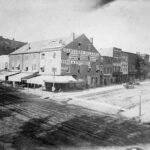
(Library of Congress/Design by Ron Coddington)
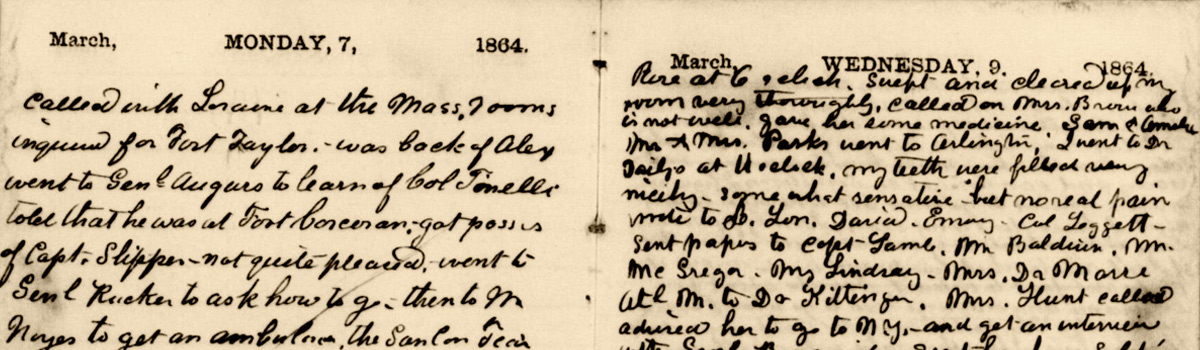
Like many Civil War families grieved by a wartime casualty, the Boissonnaults honored their fallen through a memorial grave marker. Before they learned of Madison’s fate, someone wrote to Clara Barton seeking answers. His whereabouts were likely lost after the confusion of battle, they would later learn, and his final destination would be tragically grim.
Born in Talmadge, Maine to a French-Canadian father and American mother, Pvt. Madison Frederick Boissonnault enlisted in June 1863 with Company M of the 1st Maine Cavalry. For reasons unknown, he transferred into Company H of the 1st D.C. Battalion Cavalry to participate in the defenses of Washington.2 Boissonnault did not remain in the capital city for long. Early on in the Richmond-Petersburg campaign, he was captured during the First Battle of Reams’ Station on June 29, 1864.
From the battlefield, Pvt. Boissonnault was then transferred south to Georgia, where he would be imprisoned at the notorious Camp Sumter in Andersonville. Dorence Atwater, famed documentarian of the prison’s burials, notated his death a few months later on September 11. Madison did not fare well in the summer’s horrid conditions within that enclosure, causing him to contract and perish from “scorbutus” (scurvy) due to a significant lack of Vitamin C in his diet.3
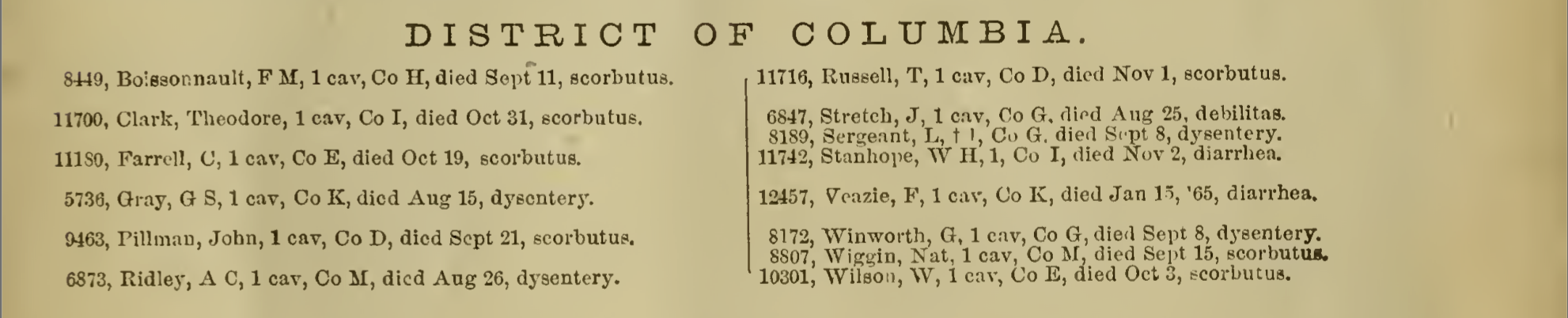
A List of the Union Soldiers Buried at Andersonville (Library of Congress)
The Boissonnaults experienced the anguish of not knowing: not knowing what happened to Madison in the wake of battle, not knowing his condition upon capture, and not knowing how he fared while confined. Clara Barton listed him in her “Roll of Missing Men,” but his story came to his natural close when the Andersonville burials were released. They carried the memory of their perished son and brother with them across the United States. One wonders if the Boissonnaults had always planned to make that cross-country trek, or if grief drove them to the other side of the nation. Placing a memorial headstone in their new home must have made it feel like Madison had journeyed with them, after all.
About the Author
Madeline Feierstein is an Alexandria, VA, historian and founder of the educational and historical consulting company Rooted in Place, LLC. A native of Washington, D.C., her work has been showcased across the Capital Region. Madeline is a writer for Emerging Civil War and the National Museum of Civil War Medicine. She leads significant projects to document the sick, injured, and imprisoned soldiers that passed through Civil War Alexandria. Madeline holds a Bachelor of Science in Criminology from George Mason University and a Master’s in American History from Southern New Hampshire University. Explore her research at www.madelinefeierstein.com.
Sources
- “Madison Frederick Boissonnault,” Find A Grave, n.d., https://www.findagrave.com/memorial/51151616/madison_frederick-boissoinault.
- “Madison F. Boissonnault,” U.S., Civil War Soldier Records and Profiles, 1861-1865, Ancestry n.d., https://www.ancestry.com/search/collections/1555/records/1328637?o_xid=115786&o_lid=115786&o_sch=Fold3&_gl=1*f0b460*_gcl_au*ODgwMjM2NjY4LjE3NjY1MDM3NTE.*_ga*OTQ0OTM5NzExLjE2NjEyNTYxNTY.*_ga_4QT8FMEX30*czE3NzA1MDQ5MDMkbzIzMiRnMSR0MTc3MDUwNDkwNyRqNTYkbDAkaDA.
- “Madison F. Boissonnault,” Andersonville Prisoners of War, Ancestry, n.d., https://www.ancestry.com/search/collections/3708/records/349.