Missing Soldier Spotlight: Lieutenant Grover Young
When thinking of reasons why people wrote the Missing Soldiers Office (MSO), it is assumed that they were family looking for loved ones. The search for Lieutenant Grover Young (or Youngs) of the 5th Kansas Cavalry initiated from a decidedly less personal source – a newspaper. Why would a newspaper be concerned with the location of a single soldier?
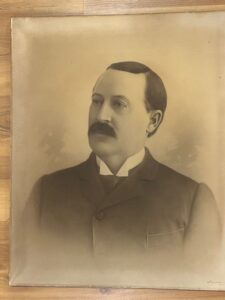
Grove A Young (FindAGrave)
Born on August 28, 1843, in Aullville, Missouri, Grover Young was the middle child of six. In an extreme stroke of luck for the time, all six children lived to adulthood. A farmer by birth, Young felt compelled to serve for the Union when the Civil War broke out. In 1861, at the age of 19, he travelled from Missouri to Leavenworth, Kansas, to join the 5th Kansas Cavalry, eventually being assigned to Company F. During his three-year tenure, Young’s accomplishments were significant enough to earn the rank of 2nd Lieutenant prior to mustering out in 1864. The peak of his military service was the Battle of Mount Elba in March 1864, in which he captured a Confederate wagon train, two battle-flags, and 260 prisoners without losing a single man. After leaving the military, he turned down offers of a major commission and a place in the Indian wars, and re-entered civilian life outside of Kansas.
In 1866, the Washington correspondent of the Kansas State Journal reached out to the Missing Soldiers Office to discover the whereabouts of Young, and his name was published on Roll Number 2. An unknown source provided a thorough update of Young’s whereabouts post-War that was subsequently published in several Kansas newspapers.
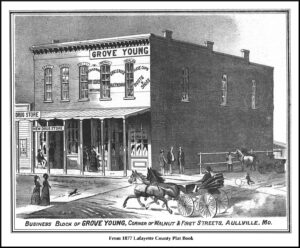
Business Block of Grove Young (FindAGrave)
After leaving Kansas, Young engaged in cotton speculation to great success. During the war, the military blockade kept the South from freely exporting goods. President Lincoln allowed raw cotton to be sold through the blockade to continue supplying northern textile needs, an effort to keep Europe out of the conflict by keeping them satisfied with cotton, and to gain the trust of assumed Unionists that lived in the South. Enormous profits could be gained from buying and selling cotton in 1864-early 1865, and Young took advantage of the moment to the tune of $10,000 (~$200,000 in 2026).
This wealth afforded trips to Europe and South America, plus an encounter with bushwhackers in Ohio while journeying south. By early 1866, Young was back home in Aullville with his father to work on the family farm. A marriage to Ella Greer in 1871 was followed by two sons, neither of whom survived beyond early adolescence.
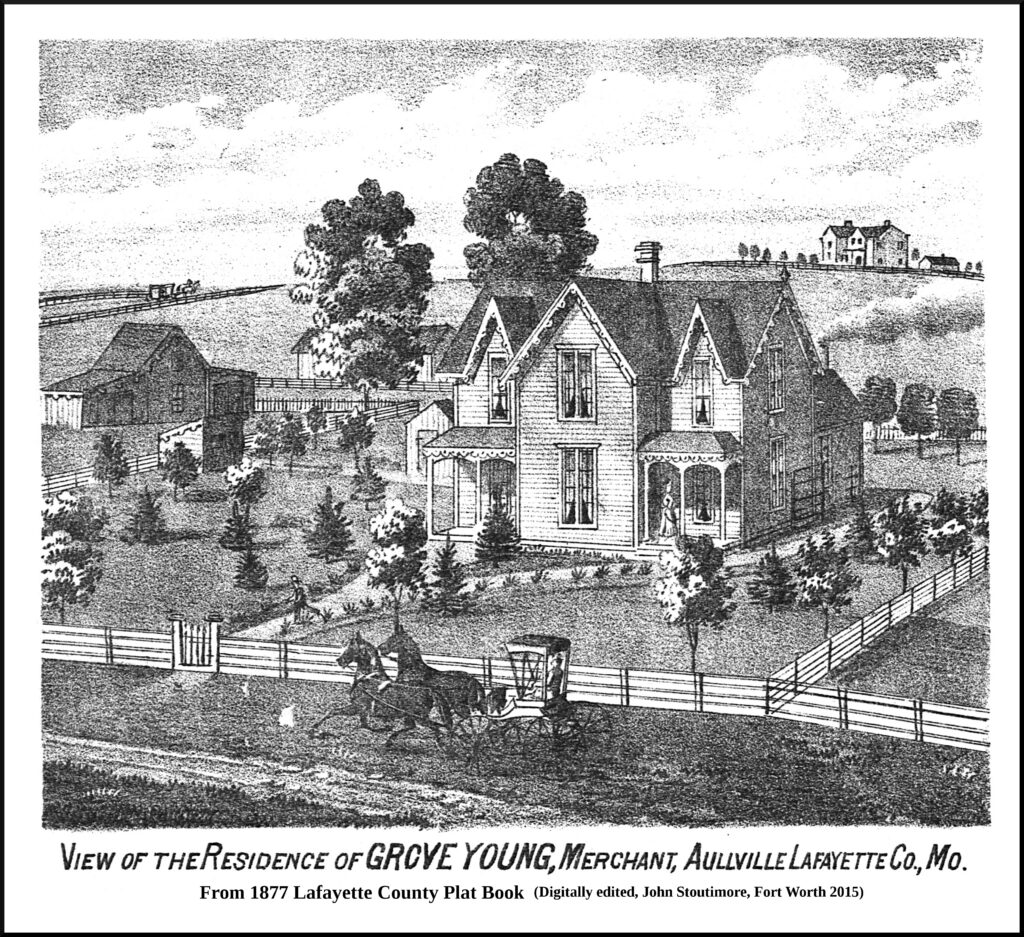
View of the Residence of Grove Young (FindAGrave)
Young was involved in legal trouble in September 1874, shooting a Mr. Willis Hill in Lexington, Missouri, over a conflict that started when Hill asked Young and his party to disarm fully while eating dinner. When the two met in the street later in the day, Young claimed that “Hill had…denounced him as a coward,” so he waited around for Hill to “demand an extraction.” Words were exchanged, Hill threw rocks, and Young fired his gun. Hill survived with three gunshot wounds, and Young was arrested. Two weeks later, the case against Young was dropped for “want of prosecution.” Any reference to Grover Young after 1874 is due to his financial success. A career shift to operating a dry goods store brought great wealth and influence, leading to his relocation to Higginsville, Missouri. It was there that Young entered the world of real estate, owning farmland throughout Kansas and Missouri.
On June 26, 1896, at the age of 56, Young died of Bright’s disease, a 19th-century term for kidney dysfunction. He was preceded in death by his wife in 1893 and his two sons. Grover Young was a Freemason, an Odd Fellow, and a staunch Democrat. He was well liked and respected, his obituary describing him as “a man of strong character, highly esteemed in business circles, of strict honor and great industry, and enterprising and public spirited in a very high degree.”
Young’s legacy is robust and well-rounded but also filled with contradiction. Why would a Missouri teenager, who grew up not too far from the heated Kansas-Missouri border during Bleeding Kansas, join a volunteer Jayhawker regiment? During Young’s tenure, the 5th Kansas burned and looted Osceola, Missouri, a town less than 100 miles south of Aullville. Why, after fighting for the Union, did Young support Confederate causes–even after his death?
Young and his brother donated to Confederate veteran events in Missouri, and Young’s will bequeathed $500 a year ($19,655 in 2026) for 35 years to the local Confederate Soldier’s home. William Quantrill, the infamous raider who Young would have fought against during the war, is interred at the Soldier’s home. Young furnished the resting place of a man who easily could have been the cause of his own death 30 years prior.
Young’s exploits post-war make it easy to assume why the presswould be curious about his whereabouts, and why so many Kansas papers printed his story. His history has instances of contradiction and moral questionability, but he ended his life respected and exalted by his peers.
A poem written in 1897 by a veteran of the 5th Kansas stated that Young’s name is one “we’ll not forget, although his work is done….” Even today, because someone at the Kansas State Journal wrote to Clara Barton to find Young, his name and life story live on.
About the Author
Jackie Walters is a volunteer at the Clara Barton Missing Soldiers Office Museum. She received her Bachelor of Science in Sports Science at Oregon State University, and works in Account Management and Product Development. As a native of Kansas, her interest in history stemmed from growing up in the land of John Brown and Bleeding Kansas.
Sources
Anonymous. (1866, July 5) Heard From. Topeka Weekly Reader. https://www.newspapers.com/image/366966520/?match=1&terms=%22grover%20young%22
Anonymous. (1874, Sep 14) Shooting Affray on Wednesday: Grove Youngs Shoots Willis A. Hill. St. Louis Republican https://www.newspapers.com/image/666933958/?match=1&terms=%22willis%20hill%22
Anonymous. (1896, July 4). A Noted Citizen Gone. Grove Young’s Death and Burial – a Short Account of His Interesting Career. The Weekly Intelligencer. https://www.findagrave.com/memorial/153851793/grove_a-young
Anonymous. (1896, July 23) Missouri News: Remembered the Confederate Home. Buffalo Reflex.https://www.newspapers.com/image/958077422/?match=1&terms=grover%20young
Jenkins. (1897, Oct 15) The Old Fifth Kansas. Leavenworth Times. https://www.newspapers.com/image/76353777/?match=1&terms=%22grover%20young%22
Scudder, T.W. (1896) Report of the Adjutant General of the State of Kansas, 1861-’65. Unknown. https://kansasguardmuseum.com/civil-war-the-5th-kansas-volunteer-cavalry/
Tags: Civil War, Clara Barton, Clara Barton Missing Soldiers Office, Missing soldiers, Missing Soldiers Office Posted in: Uncategorized