Missing Soldier Spotlight: Captain Lewis S. Tilton
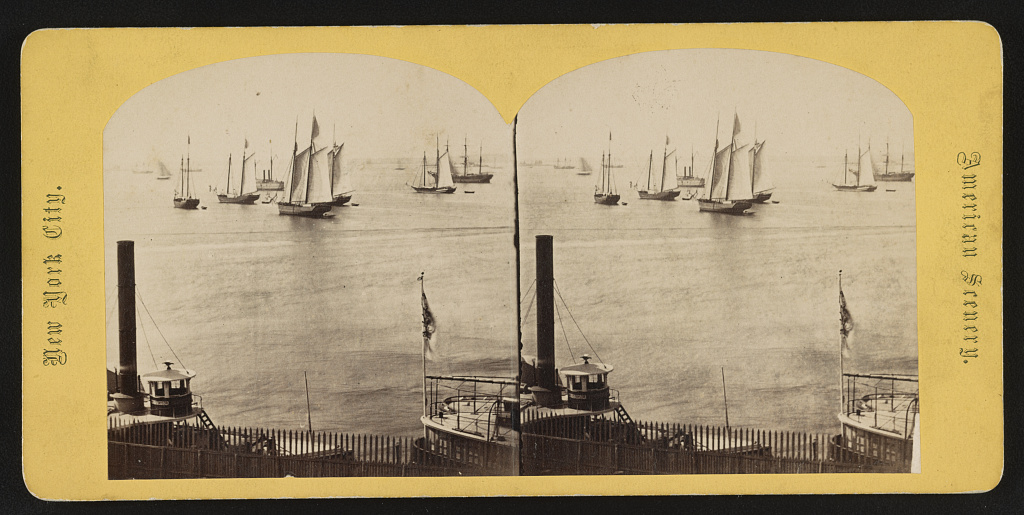
A fleet of Schooners (Library of Congress)
In August of 1863, President Lincoln praised the efforts of the Union Navy: “…Nor must Uncle Sam’s Web-feet be forgotten. At all the watery margins they have been present. Not only on the deep sea, the broad bay, and the rapid river, but also up the narrow muddy bayou, and wherever the ground was a little damp, they have been, and made their tracks.” Despite the presidential compliments, naval efforts of the Union and the Confederacy are often not included in school curriculum or in sweeping summaries of the Civil War. But, as James McPherson argues in War on the Waters, the Civil War “could not have been won without the contributions of the navy.”
While most men on the Rolls of Missing Men are from the Army, there are approximately 50 Naval personnel listed on the Rolls, whether it be stewards, sailors, or captains. One such man is Captain Lewis Steelman Tilton of Egg Harbor, Atlantic County, New Jersey. Tilton was born on May 25, 1832, and died at the age of thirty-two in March of 1864, when he was lost at sea. A local newspaper, The South Jersey Republican, addressed the departure of the schooner R.H. (also seen as H.R.) Coggshall (also spelled as Coggeshall) from Philadelphia in March 1864 enroute to Beaufort, South Carolina. The ship may have been part of the Union blockade, crucial to preventing the import and export of Confederate goods, or it could have been transporting supplies for the Union. Philadelphia served as a production and repair center for Union ships.
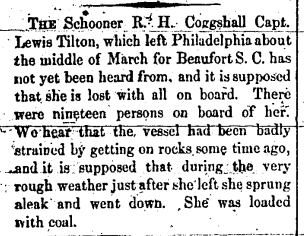
South Jersey Republican, May 7, 1864 (Library of Congress)
Tilton was born in Atlantic County, New Jersey into a large family with nine siblings. Sadly, three of his siblings died as children. He married Caroline Lake in December 1854 in Bakersville, New Jersey, and they had four children – Ellwood, George, Laura, and John.
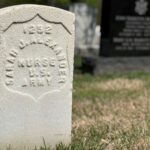
Lewis S. Tilton did not join the Navy until 1863. His name is found in the New Jersey Draft Papers, Class 1, alongside that of his younger brother, John, Class 3. The younger Tilton would also perish in 1864, and there is a possibility that the two served on the same ship. Their graves are next to each other in Zion Methodist Church Cemetery in Egg Harbor Township – Lewis Tilton’s gravestone reads “lost at sea.”
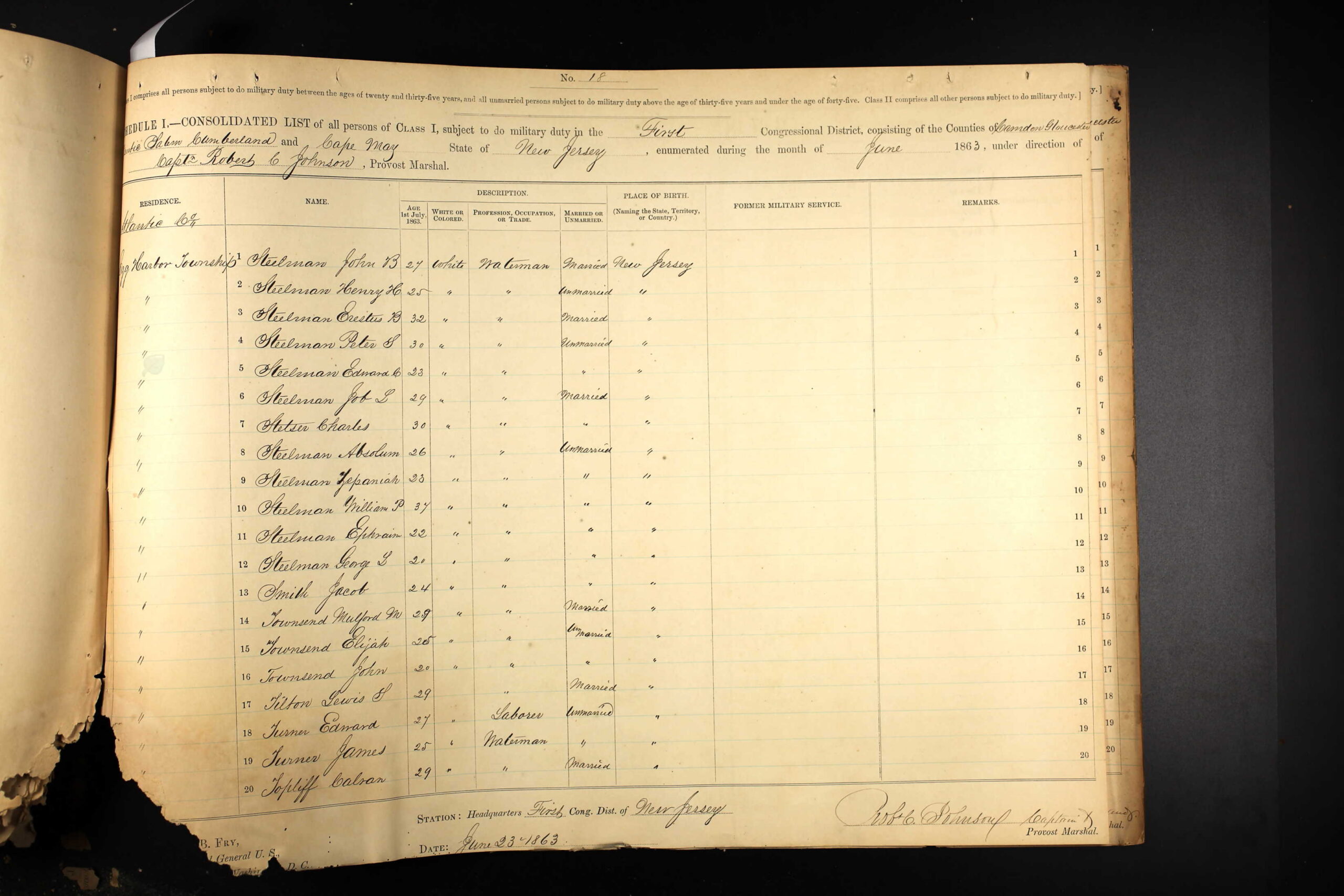
Class 1, Alpha. By C.o.s of Camden, Gloucester, & Atlantic, Volume 1 of 3 (National Archives)

Class 1, Alpha. By C.o.s of Camden, Gloucester, & Atlantic, Volume 1 of 3 (National Archives)
On April 19, 1861, Abraham Lincoln proclaimed a naval blockade against the seceded states under international law. The goal was closure of the southern ports, and, as McPherson writes, “by imposing a blockade, the United States treated the Confederacy as a belligerent power but not as a nation.” The British minister to the United States, Lord Lyons, encouraged Lincoln in this action because Britain would respect a blockade imposed under international law.
However, the blockade was, as some historians have called it, a leaky sieve. Five out of six blockade runners got through – some 8,000 successful trips compared with about 1,500 runners captured or destroyed. It should be noted, though, that the ratio for steamers importing or exporting goods was lower: of some 1,300 attempts, about 1,000 got through. Export of cotton would have helped finance the war, and without complete success, the economy of the Confederacy struggled. Successful internal and international trade would have aided the Confederacy, but the Union blockade, while porous, was a force to be reckoned with.
During his service, Tilton was the captain of a schooner. In the 19th century, schooners were popular because of their speed, as well as their smaller size, which meant a compact crew and more space for cargo. In Tilton’s case, his ship was carrying coal. During the Civil War, schooners played several roles, including blockade running and enforcement. Other schooners were enforced with mortars, explosive shells to fire upon Confederate shores, or transporting supplies.
The growth of the Union Navy, in both men and ships, should also be noted. When the war began, the Navy consisted of sailors and officers of all ranks, numbering from about 7,600 enlisted men and 1,200 officers. Gideon Welles, the Secretary of the Navy, encouraged Lincoln to call for the recruitment of 18,000 men for terms of one to three years. By early 1865, the ranks consisted of 51,500 men and 16,880 mechanics and laborers. The Union Navy also differed from the Union Army in other aspects, including age and origin. Men of the Navy were slightly older, and many came from urban spaces and had working-class jobs. Ninety-two percent of Navy men were from New England and mid-Atlantic states, and unlike the Army, the Navy was not segregated. There was also a higher percentage of foreign-born men in the Navy.
While Captain Tilton’s time in the Union Navy was limited, his service was honorable. Leaky sieve or not, the accomplishments of the Union Navy in battle, blockading, and conquering crucial southern cities like New Orleans, must be remembered.
About the Author
Kate Gottsman is a volunteer docent and writer at the Clara Barton Missing Soldiers Office Museum. She received her Bachelor of Arts from the University of Georgia in History and English with a certificate in Museum Studies. She is currently a master’s student in Museums, History, and Culture at the George Washington University, specializing in curatorial studies and 19th-century America.
Sources
Library of Congress
National Archives
Missing Soldiers Roll No. 2
“History.” Navy Yard Philadelphia. Accessed July 27, 2026. https://navyyard.org/about/history/
McPherson, James M. War on the Waters: The Union and Confederate Navies, 1861-1865. Chapel Hill, University of North Carolina Press, 2012.
Surdam, David G. “Northern Naval Superiority and the Economics of the American Civil War.” The Journal of Economic History 56, no. 2 (1996): 473–75. http://www.jstor.org/stable/2123979.
Still, William N. “A Naval Sieve: The Union Blockade in the Civil War.” Naval War College Review 36, no. 3 (1983): 38–45. http://www.jstor.org/stable/44636370.
Stacy, George, Publisher. A fleet of Schooners. New York, New York Harbor New Jersey, ca. 1865. [New York, N.Y.: George Stacy] Photograph. https://www.loc.gov/item/2017647704/.
Bailey, Grace. “Golden Age of Sail: America’s First Schooners.” Sail Grace Bailey. Accessed July 27, 2026. https://www.sailgracebailey.com/firstschooners
De Soria, Oliva. “What You Need To Know About Schooners.” Boat Mart, December 5, 2025. Accessed July 27, 2026. https://www.boatmart.com/blog/2024/09/18/what-you-need-to-know-about-schooners/
Tags: Civil War, Clara Barton, DC, Missing soldiers, Missing Soldiers Office, Washington DC Posted in: Uncategorized