‘I have, I fear grown a little sad and discouraged’: Clara Barton Reflects on 1865
On December 18, 1865, following the ratification of the 13th Amendment, President Andrew Johnson addressed the United States Senate. He declared:
I have the honor to state that the rebellion waged by a portion of the people against the properly constituted authority of the Government of the United States has been suppressed; that the United States are in possession of every State in which the insurrection existed, and that; as far as it could be done, the courts of the United States have been restored, post-offices reestablished, and steps taken to put into effective operation the revenue laws of the country.
The final month of the closing year of the Civil War was a tough one for Clara Barton. For the past five years, she had been rendering aid in hospitals and on battlefields. She had left a comfortable life in civil service to volunteer as a nurse. Her reputation as the prominent humanitarian, the Angel of the Battlefield, was known across the reunited country. The 1865 U.S. Army Quartermaster expedition to Andersonville prison, which she had been essential in organizing, left her feeling unfulfilled. The federal government had not given her a dime of compensation. Nor were they willing to financially support her new endeavor locating missing men.
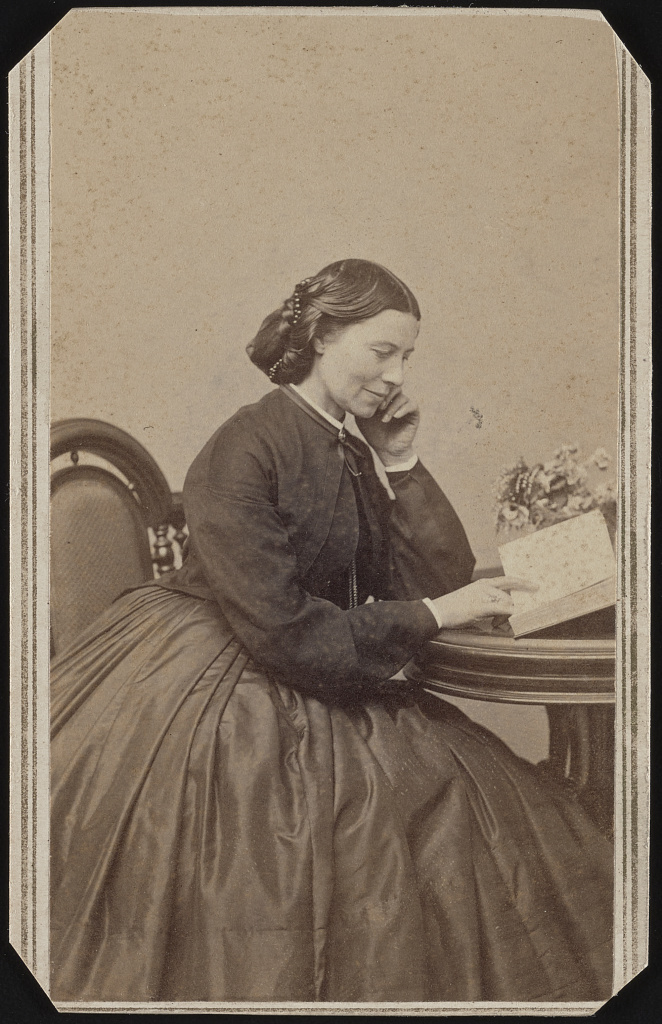
Clara Barton in 1865 (Library of Congress)
Two losses in particular pained Clara that winter: the loss of her brother, Stephen, and her nephew, Irving, both in Spring 1865. She had been close with both and nursed them as they lay in their sick beds, but couldn’t save either.
Clara’s experience mirrored many in the country at the time. Two percent of the U.S. population had been killed in military service during the war. There was rarely a family untouched by it. Many of the war’s casualties were buried in unmarked graves far from those who mourned them. Buildings, farms, and some entire cities lay in ruins. Millions of civilians grappled with the world the war had created. Discharged veterans adjusted to their return to civilian life. And four million newly emancipated individuals officially had their freedom permanently guaranteed with the ratification of the 13th amendment. In the victorious loyal states, paraphernalia such as lithographs with messages of peace and optimism were popular gifts. The entire reunited country sought a way to move forward after the war.

A Patriotic New Year’s Message 1866 (Library of Congress)
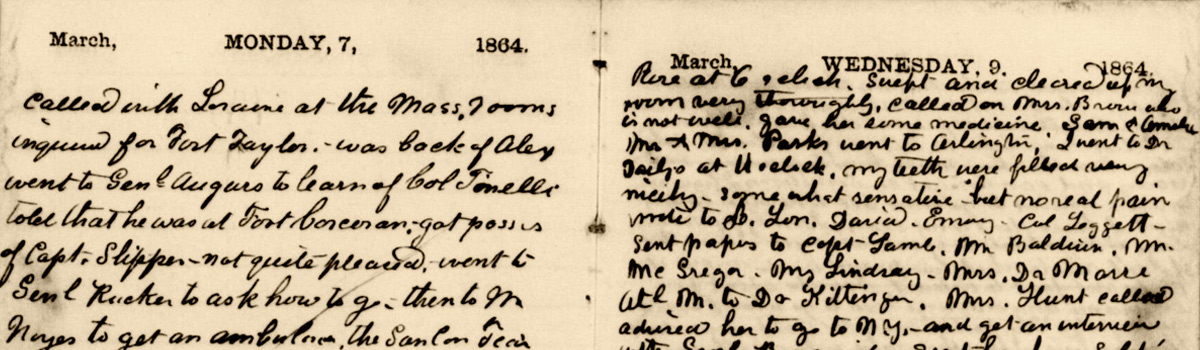
On New Year’s Day 1866, Clara reflected on her challenges of 1865 and how she felt about the coming year.
January 1, 1866
I have just closed one of the hardest and most trying years of my life. Not that it has been the most useless, or will amount to the least in the end, but has been hard to live. — I have attempted to carry on a great work with inadequate means. I have required counsel & friends, as well as money to accomplish my purposes. My friends although well meaning in the main have been powerless, this I suspect I have sometimes construed into inefficiency or possibly indifference, which made me very miserable. I must, and indeed have as soon as detected in myself, cast all such reflections aside, and studied to be grateful for what was done to aid me, striving to forget what was not.
….
These have been my vexations during the past year – but my afflictions have been of a far different character. Within these 12 months I have parted with the two who perhaps in the old time has twined the most deeply about my heart, who had traits of character more in common with myself than any others, where love for me was a mine of wealth, and around whose dear memory the tenderest fibers of my heart still cling and crushed & torn, and buried still ache & bleed. Poor dear old Brother Ste. on the 10th of March, and Bably Quins on the 9th of April, I cannot always feel that they are quite gone – and sometimes they both seem very near me. I have never felt the partition so thin between the two worlds as since they left us and I knew they had gone to the other side, – it has grown to be only a veil, a gauze, and I can almost feel them through it.
I have I fear grown a little sad and discouraged, and until today I have a for a long time been quite disheartened, but with the commencement of the New year, I have commenced a new life. determined to follow closely my own purposes, strive to accomplish something for myself; accordingly I have closed my doors upon all, and sat down to write some lectures for reading in public, if I should be so far fortunate as to make me ready and be tolerably well received by the public, I went out with my little faithful friend Jules to find some work in the Rebellion. Abbots is not in vain, and the right volumes of the Rebellion record at 5,00 apiece places it beyond my reach for the present – so I returned and sat down to a retrospect of my own personal diary unaided by history.
About the Author
Roy Blumenfeld is a history enthusiast and volunteer docent at the Clara Barton Missing Soldiers Office Museum. He holds a BS in Political Science from Appalachian State University.
Sources
Websites
- “Clara Barton Papers: Diaries and Journals, 1865.” Library of Congress, https://www.loc.gov/item/mss119730011/
- “Clara Barton Papers: Diaries and Journals, 1866.” Library of Congress, https://www.loc.gov/item/mss119730013/
- “Civil War Casualties.” American Battlefield Trust, https://www.battlefields.org/learn/articles/civil-war-casualties
- “Slavery Abolished.” National Geographic, https://education.nationalgeographic.org/resource/slavery-abolished/
- “December 18, 1865: Announcement of the Successful Suppression of the Rebellion.” Presidential Speeches, Miller Center, University of Virginia, https://millercenter.org/the-presidency/presidential-speeches/december-18-1865-announcement-successful-suppression-rebellion