Fire Codes and Our Forgotten Floor: How the Triangle Fire Shaped Clara Barton’s Legacy
In 1911, an unlikely connection emerged between the Triangle Shirtwaist Factory fire and the Clara Barton Missing Soldiers Office. The Triangle Shirtwaist Factory was a garment factory in New York City that employed hundreds of workers, primarily young immigrant women, who labored long hours in crowded and often unsafe conditions. On March 25, 1911, a devastating fire swept through the factory, killing 146 workers, many of whom were trapped by locked doors or unable to escape. The tragedy sparked widespread outrage and prompted sweeping new fire and building codes, some of which would ultimately help preserve the building at 437 7th Street that had once held Clara’s living and working space, protecting Clara Barton’s history in the building and memorializing it for future generations.
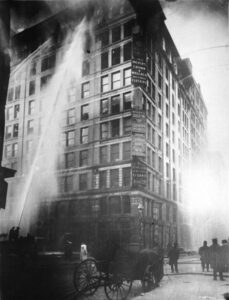
Image of Triangle Shirtwaist Factory fire on March 25 – 1911, Wikimedia
The Triangle Shirtwaist Factory fire was a brutal wake up call for the U.S. government, that had long neglected fire safety measures. Between 1911-1915, fire safety improved as probes into the tragedy revealed a nightmarish lack of fire safety legislation. By the end of 1915, buildings with more than two stories were expected to have stable, functioning fire escapes, more than one stairwell/exit on each floor, proper ventilation, some form of fire extinguisher, and outward-opening doors. Building owners across the country, buzzing with a newfound fear of the government inspector, faced mountainous renovation bills as they rushed to modernize their buildings. Those who did not have the time, energy, or funding to implement the necessary updates often chose to sell their properties or close their top floors. In a decision that would not be historically significant until nearly a hundred years afterwards, the owners of 437 7th Street NW, otherwise known as Clara Barton’s former residence, chose simply to board up their third floor. It would take 80 years until the Missing Soldiers Office regained its identity. The well-preserved, original layout of the third floor, as well as the mostly damage-free condition of the historical materials inside it, helped facilitate the identification and preservation of the site when the building was inspected prior to its proposed demolition in 1996 and its identity discovered by inspector Richard Lyons. The link between Clara Barton and the victims of the 1911 tragedy does not end there.
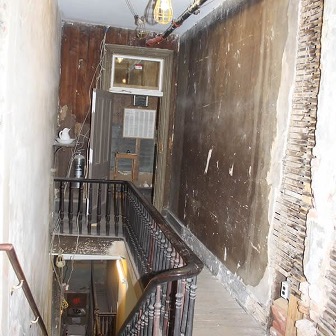
The third floor of the Missing Soldiers Office before renovation, Evergreene Architectural Arts
Clara Barton’s vision of the Red Cross as a civilian aid organization allowed the families of Triangle fire victims to receive support, acknowledgment, and fiscal compensation. The aid given by the Red Cross, and the meticulous documentation they kept of victims’ lives and circumstances, supported victims’ families for generations and forever preserved the memory of the loved ones lost
Before the flames had even been extinguished, Red Cross staff were outside the Asch building, underneath the large Triangle Shirtwaist Factory sign and the smoking windows, preparing themselves for what was to come.
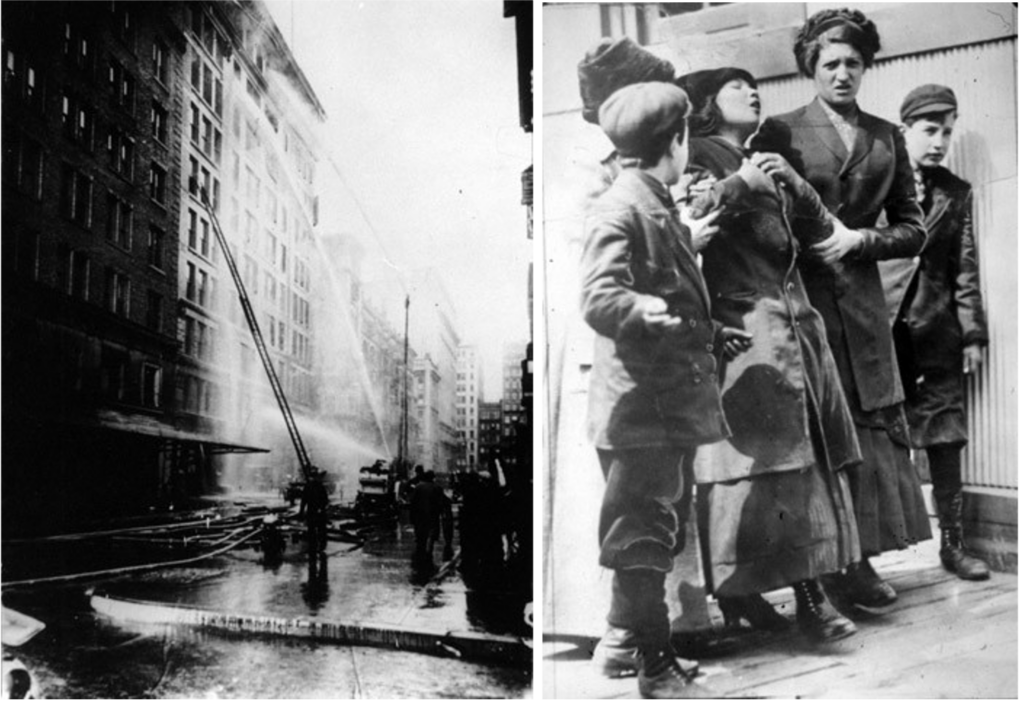
Firefighters battle the fire at Triangle, Cornell University Kheel Center. A distraught family member leaving the morgue after identifying her loved one, Cornell University Kheel Center
After the injured were evacuated and the situation calmed, the Red Cross got straight to work. They, along with multiple other aid organizations and private donors across the city, amassed a total of $103,000 for victims and bereaved families. After this money was raised, diligent social workers employed by the Red Cross visited or inquired after every bereaved family, evaluating theirsocioeconomic and psychological circumstances. In cases where they could not contact a family in person, as was the case with all families still living in Eastern Europe or Italy, they waited months for reports to be returned from consulates or private contacts. Using information gleaned in the social workers’ reports, the Red Cross allotted a set amount ofmoney for each family, rarely less than $200, and capped out at $5,000. Often, survivors/family members who were especially struggling in the wake of the tragedy, were sent to countryside convalescent homes on the Red Cross’s dime, where they were encouraged to stay until their spirits improved. The Red Cross also, upon request, purchased tickets to America for overseas relatives of the deceased, set up funds for family members to establish businesses, and reimbursed the cost of lost/destroyed clothing.
This benevolent system was largely Clara Barton’s design and was born directly from her idea of how an aid organization should function. It was people first and profit second, just as she had intended. Throughout the Red Cross’swork with the families of the Triangle fire victims, key details of each victim’s life and circumstances were painstakingly recorded, ensuring that their memory lived long past even those who worked to document it. The ambition and sacrifices of both the Triangle Shirtwaist Factory fire victims and Clara Barton contributed to the immortalization of their stories.
About the Author
Abigail Fuller is part of the Guest Services team at the Clara Barton Missing Soldiers Office Museum. She received her BA in History at the University of Mary Washington with a concentration in museum studies. She specializes in Jewish and 20th century history.
Sources
Red Cross Emergency After the Washington Place Fire. New York, New York, 1912.
Significant Dates in Red Cross History. American Red Cross.
People of New York vs. Isaac Harris and Max Blanck (Manhattan, New York November 1911).
Tags: Civil War, civil war medicine, Civil War nurses, Clara Barton, Clara Barton Missing Soldiers Office, DC, Missing Soldiers Office, Nurse, Red Cross, Women's History Posted in: Uncategorized