Clara Barton and the American Revolution
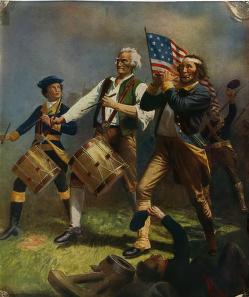
The Spirit of ‘76 (Library of Congress)
As America celebrates its semiquincentennial, the 250th anniversary of our founding, there is no better time to explore Clara Barton’s ties to the nation’s birth. At the outbreak of the American Civil War in 1861, the conflict where Barton became known as “The Angel of the Battlefield” for her trailblazing work as a nurse at the front lines, the nation was only 85 years old. A handful of people who had lived through the founding were still alive to see another war threaten to tear it apart. The legacy created by the founding generation heavily influenced Barton’s life; she inherited a patriotic spirit that would redefine American volunteer humanitarianism.
Barton’s hometown of North Oxford, Massachusetts, wasn’t founded until decades after the American Revolution. But Worcester County, where North Oxford is located, was a hotbed of Revolutionary activity. On September 6, 1774, seven months before the first shot of the Revolutionary War would be fired at Concord’s North Bridge, a force of more than 4,600 patriot militiamen from Worcester County seized the local court house.
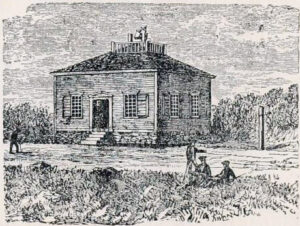
Worcester County Court House (Historic Ipswitch)
The militia prevented the colonial court from opening, stifling British authority over the county. Court officials were forced to recant their oaths to the king and leave the area under duress, completely unsupported by the British Army 40 miles away in Boston. Despite having advanced knowledge of the plot, the British did not send troops to secure the court, nor did they attempt to reopen it. The bloodless show of force against the British would become known as the Worcester Revolt. British forces pointedly avoided Worcester County for the duration of the war due to its reputation as a revolutionary hotbed.
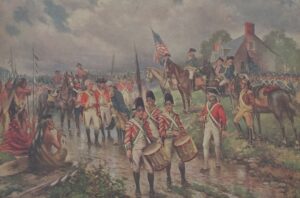
British Surrender at Saratoga (Library of Congress)
Ebenezer Learned of Oxford, Massachusetts, was one of Worcester County’s highest ranking patriots. Clara Barton was his great grandniece. Learned led troops in numerous battles from the Siege of Boston through the critical Saratoga Campaign. This victory inspired the French to support the cause of American independence.
Learned was also present for the winter encampment at Valley Forge. He finished the war with the rank of Brigadier General. After resigning his commission in 1778, he returned to Oxford and practiced law until his death in 1801.
Both of Clara Barton’s grandfathers served during the American Revolution: Corporal David Haven Stone was her maternal grandfather, and Dr. Stephen Barton was her paternal grandfather. Dr. Barton served as a delegate to the Committee of Correspondence, a key communication network that kept patriots across the colonies informed, and the Committee of Safety, which was concerned with arming and preparing local militias.
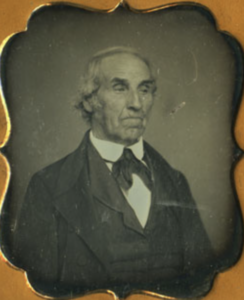
Captain Stephen Barton Jr. (FindAGrave)
Dr. Barton’s patriotism was passed to Clara Barton’s father, Stephen Barton Jr. He was born in 1774, the same year as the Worcester Revolt. Too young to fight in the Revolutionary War, Barton Jr. would enlist for the independent republic upon coming of age. He served in the newly created United States Army under General Anthony Wayne. He fought against Native Americans in the Northwest Territory. After leaving the Army in 1796, Stephen Barton Jr. returned to Worcester County, married, and had five children including Clara Barton. His rank of Captain was bestowed upon him as a community honor for local militia service as opposed to his time in the United States Army.
As a child, Clara Barton grew up in awe of her father’s service and American military history. As the youngest child by a significant age gap, Clara spent a lot of time with her father. He would teach her military tactics and tell her stories from his service days; she loved it and yearned to be a soldier one day.
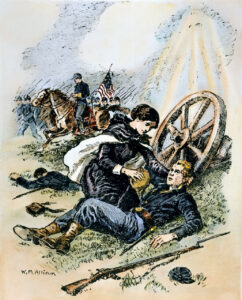
Clara Barton at Antietam (W.M. Allison)
Captain Barton was still alive at the start of the Civil War and strongly supported the Union cause. In spite of societal norms around gender dashing Clara’s dream of soldiering, he encouraged his daughter to participate in the conflict however she could. In March 1862, Clara left Washington, D.C. and visited her family home in North Oxford after receiving news her father’s health was in decline. With a torn heart from seeing her father near death, she also could not hide her frustration from him about her inability to do more for the war effort. In one of their final face-to-face conversations, Captain Barton encouraged Clara to keep pushing by telling her from his experience that soldiers would respect her and that she should seek out those in need to serve. Within weeks of their conversation, Captain Barton died. But by the end of 1862 his desire for his daughter to serve at the front lines had come to fruition. Just as he predicted, the soldiers were extremely grateful for her presence.
After the Civil War ended, Clara Barton spent the rest of her life as a leader in humanitarian and patriotic causes. In 1890, she was a founding member of the Daughters of the American Revolution (National Number 160) and served as the organization’s first Surgeon General. Her legacy with DAR continues to this day. Since 1974, the Clara Barton Chapter of the National Society of the Daughters of the American Revolution has been active in Huntington, California.
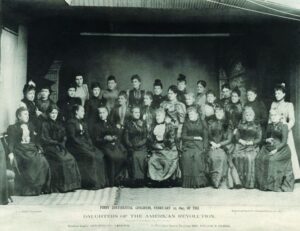
First Daughters of the American Revolution Congress (DAR)
About the Author
Roy Blumenfeld is a history enthusiast and volunteer docent at the Clara Barton Missing Soldiers Office Museum. He holds a BS in Political Science from Appalachian State University.
Sources
Websites
- Bernstein, Melvin H. “Setting The Record Straight: The Worcester Revolt of September 6, 1774.” Massachusetts Society, Sons of the American Revolution, 23 Jan. 2013, https://massar.org/setting-the-record-straight-the-worcester-revolt-of-september-6-1774/
- “Chapter History.” Huntington Beach Chapter, National Society Daughters of the American Revolution, https://huntingtonbeach.californiadar.org/index.php/about-us/chapter-history
- “Committed to Service: The DAR and the American Red Cross.” National Society Daughters of the American Revolution, https://www.dar.org/national-society/celebrate-125/committed-service-dar-and-american-red-cross
- Ebenezer Learned Valley Forge National Historical Park, Independence Hall Association, https://www.ushistory.org/valleyforge/served/learned.html
- “Father and Offspring: Revolutionary War Veterans and Their Civil War Children.” American Battlefield Trust, https://www.battlefields.org/learn/head-tilting-history/father-offspring
- Harris, Gordon. ““A State of Nature”, Worcester in 1774.” Historic Ipswich, 5 Dec. 2022, https://historicipswich.net/2022/12/05/a-state-of-nature-worcester-in-1774/
- “Dr Stephen Barton.” Find a Grave, 14 Sept. 2008, https://www.findagrave.com/memorial/29575027/stephen-barton.
- Robinson, Tracy. “Tales from the Archives: A Look Back at DAR’s First Year.” Today’s DAR, National Society Daughters of the American Revolution, 11 Oct. 2021, https://blog.dar.org/2021/10/11/tales-archives-look-back-dars-first-year.
Books
- Oates, Stephen B. Woman of Valor: Clara Barton and the Civil War. Kent State University Press, 1996.
- Barton, William E. The Life of Clara Barton: Founder of the American Red Cross. Vol. 1, Houghton Mifflin Company, 1922. https://www.gutenberg.org/files/67505/67505-h/67505-h.htm