Artifact Spotlight: The Bayonet
The only weapon on display at the museum is a rusty socket bayonet discovered in 1996 by Richard Lyons in the attic with the rest of Clara Barton’s belongings It can now be found in a case on the third floor. As the building was a boarding house during the Civil War, and there is no record of it being a military site, you have to wonder why a bayonet was tucked away in the attic.
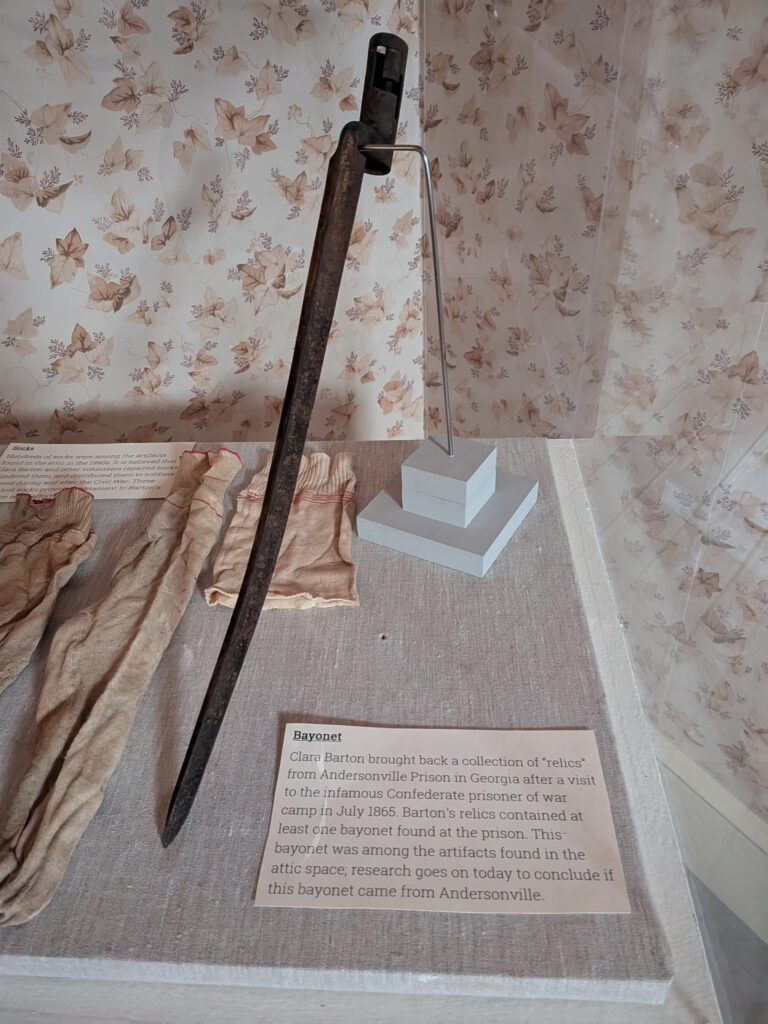
Bayonet Found in Attic Above Clara Barton’s Room (Missing Soldiers Office Museum Collection)
A bayonet is a long blade that can be attached to the barrel of a rifle. The first bayonets were used by the French in the 17th century, and by the time of the American Civil War they were mass produced. Over 1 million bayonets were made by American factories or imported from Europe over the course of the war. The most common type used in the conflict was a socket bayonet: a triangular steel blade extending out from a hollow socket that fit directly over a rifle’s muzzle. The socket would lock into a lug or forward sight on a rifle, which allowed soldiers to load and fire their weapon without interference from the bayonet. Soldiers were trained on how to use them through drills, the most common were those outlined in the prewar 1852 Manual of Bayonet Exercises by George B. McClellan.
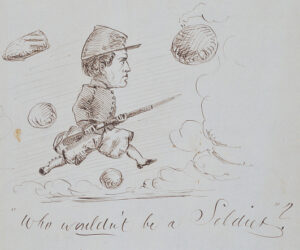
Charge Bayonets. “Who Wouldn’t be a Soldier?” Cartoon by B.H. Ticknor, 45th Massachusetts (Library of Congress)
The order to “fix bayonet” and charge has a certain mythos around it. The thought of hundreds or thousands of yelling Civil War soldiers with long blades at the tips of their guns ready to thrust them into their enemy is quite a scary image. But in reality, using a bayonet during a battle for hand-to-hand combat was highly uncommon. Bayonets accounted for only 1.6% of all wounds suffered by Union soldiers during the war. During a typical battle, soldiers from one side would usually retreat away from the attackers or be repulsed by defenders from a distance before a chance to engage in hand-to-hand combat occurred.
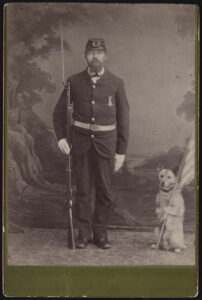
Portrait of a Civil War Veteran in Grand Army of the Republic Uniform with Bayonet Fixed (Library of Congress)
Despite their uncommon deployment on the battlefield, bayonets were not trinkets. They still served as a valuable weapon of intimidation when a soldier was posted on guard duty. Soldiers also found a variety of non-lethal uses for them including serving as a hook for a pot (if the blade was twisted) or a skewer for meat when preparing food, a tool for digging everything from fire pits to makeshift trenches, a candle holder, or a tent stake. Many soldiers liked to get photographed in uniform with their bayonet affixed to their rifle, making them a part of their martial identity.
Clara Barton could have come into possession of a bayonet in any number of ways. Being on the front lines and in army camps so often, Barton had numerous opportunities to obtain one. It was common practice in the 19th century for soldiers and civilians alike to gather relics from battlefields. We know for certain Barton partook in the practice, but not just for the purpose of collecting curiosities.
Barton visited Camp Sumter, more commonly known as Andersonville, in the summer of 1865 as part of the Army Quartermaster’s expedition to properly bury the dead. Andersonville was thought to be the worst prisoner of war camp on either side with cramped conditions, no shelter beyond the tents or holes the prisoners made themselves, no clean water source, and a high death rate. The war was over and the prison was empty when Barton arrived, but it remained a ghastly sight.
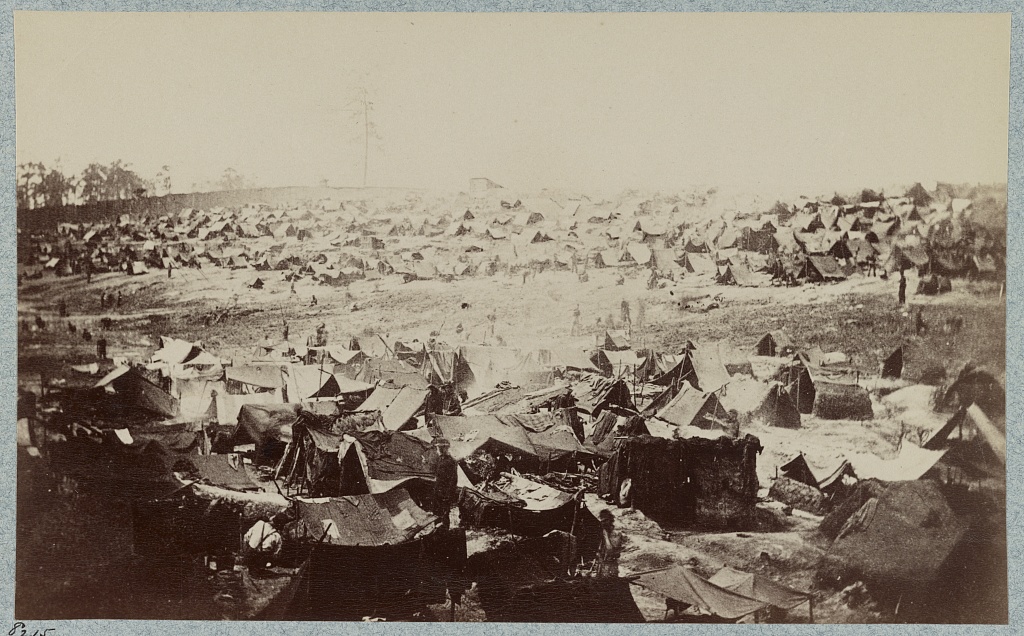
Andersonville Prison (Library of Congress)
Barton collected relics as a chance to gather evidence for potential use in trials or hearings about Confederate crimes and for the public who could not travel to rural Georgia to see the depraved conditions themselves. She wrote about the meaning of objects in her relic collection to members of Congress and in letters published in newspapers. When Barton returned home to Washington, she displayed them in her parlor. A photographer from Mathew Brady’s nearby studio on 7th Street took a photograph of her Andersonville relics. Later, she sold trading card-sized mass printed Carte de Visite copies of the image at the National Fair of 1866 to benefit veterans and their families. Brady’s studio held the image copyright and also sold copies, but not for charity. In February 1866, Barton visited Congress and mentioned gathering relics in her testimony about Andersonville before a House committee.
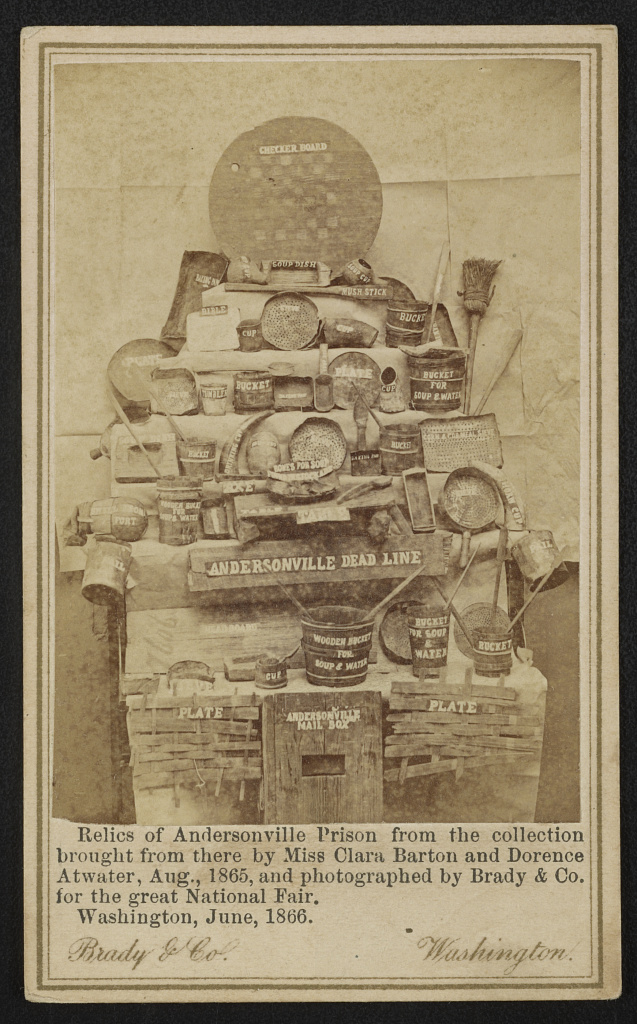
Clara Barton’s Relics of Andersonville Prison (Library of Congress)
The leading evidence for the bayonet found in the attic being a relic gathered from Andersonville Prison comes from Barton’s friend Frances Gage. In an 1866 letter meant for newspaper publication as a measure of support for Congressional funding for the Missing Soldiers Office, Gage described Barton’s Andersonville relics that had already become well-known from the photograph.
But let us look further. These bayonets were picked up in that Golgotha, and this letter-box, into which thousands, ay, tens of thousands of letters were dropped, but never one went out to gladden the oppressed hearts of friends! Perhaps no five pieces of timber were ever nailed together, that have enclosed so many tales of distress, or so few of happiness or joy, as these.
The “letter-box” Gage referenced directly after the bayonets is in the relic collection photograph, labeled as “Andersonville Mail Box.”
While Gage’s letter is far from conclusive about the origin of the bayonet, we may never know more.
About the Author
Roy Blumenfeld is a history enthusiast and volunteer docent at the Clara Barton Missing Soldiers Office Museum. He holds a BS in Political Science from Appalachian State University.
Sources
Books
- McClellan, George B. Manual of Bayonet Exercise: Prepared for the Use of the Army of the United States. 1852. DrillNet, www.drillnet.net/Bayonet.htm.
- Raab, Jennifer. Relics of War. Yale, 2015
Websites
- “The Bayonet.” The Civil War Monitor, www.civilwarmonitor.com/article/the-bayonet/
- “United States—19th Century.” World Bayonets: Bayonet Identification Guide, www.worldbayonets.com/Bayonet_Identification_Guide/United_States__19th_Century_/us_19th_century_2.html
- “Artifact Series: Bayonet.” Clara Barton Missing Soldiers Office Museum, clarabartonmuseum.org/artifact-series-bayonet/
- “Relics.” Clara Barton Missing Soldiers Office Museum, clarabartonmuseum.org/learn/studentresearch/relics/