A Shelter to Which I Might Return: Clara Barton’s Seventh Street Home
For more than 170 years, a modest brick building has stood on Seventh Street, situated in downtown Washington, D.C. Throughout that time, its storefronts have changed hands again and again. Its address has changed, and its façade has been covered over and rebuilt. Through all of it, the rooms on its third floor held a chapter of Civil War history that few people walking past would have guessed.
In the 1840s, the lot where the Clara Barton Missing Soldiers Office Museum stands today was assessed to Raphael Semmes (also recorded as “Simmes”). In 1853, he commissioned the building that stands there today. Its design was typical of mid-19th-century Washington: a granite threshold leading into a small vestibule, straight staircases rising to the upper floors, and narrow hallways on each level. Three stores fronted the street on the first floor. Offices filled the second. The third floor was as visitors see it today: rooms for boarders. By 1855, city directories listed a Patent Office clerk, a merchant tailor, and an office of the Y.M.C.A. among its tenants.
In 1857, the building was purchased by Susan Ireland, a wealthy widow born Susannah Fowler, who appears to have bought it as an investment and never lived there. The third floor was managed by a tenant, Edward Shaw, a Patent Office employee from Attleboro, Massachusetts, who had lived in the building since at least 1855 and sublet its rooms to other tenants. At the time, the building’s address was 488½ Seventh Street.
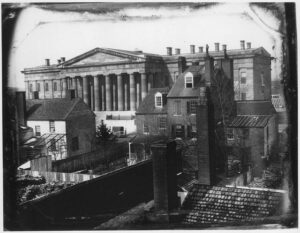
United States Patent Office, Library of Congress
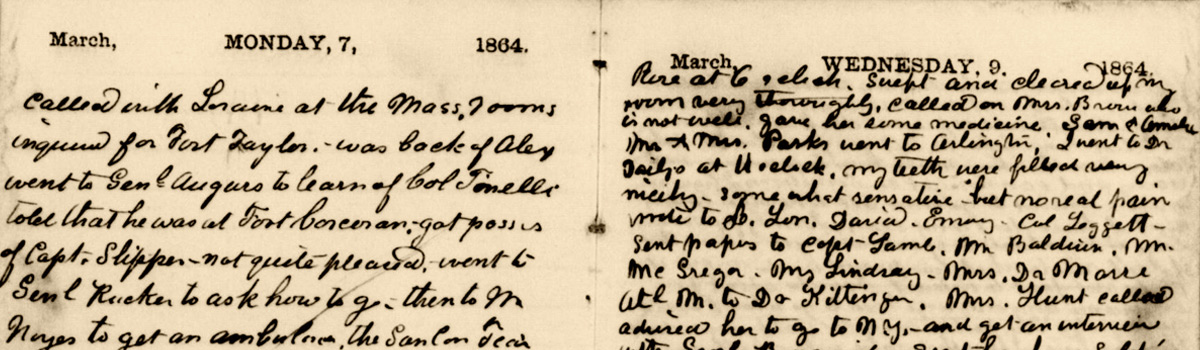
In 1861, just prior to the onset of the Civil War, Clara Barton moved to Washington, D.C. for a second time and regained a position at the nearby Patent Office, today where the National Portrait Gallery stands. She rented a single room on Shaw’s third floor, likely along the north side of the building. Over the next seven years, the rooms served as her home, as a storeroom for the supplies she carried to the front, and finally as the headquarters of the Office of Correspondence with Friends of the Missing Men of the United States Army – more commonly known as the Missing Soldiers Office. During the Civil War, she was rarely there. In December 1863, Barton wrote to Patent Commissioner D.P. Holloway that she had used part of her salary to keep a room she seldom occupied, “retaining it merely as a shelter to which I might return, when my strength should fail me under exposure and labor at the field.”
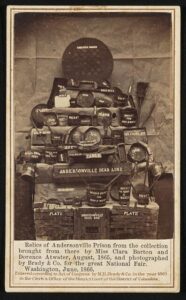
Relics of Andersonville Prison, Library of Congress
At the close of the Civil War, as the Missing Soldiers Office grew, Barton expanded into additional rooms. By November 1865, she wrote that with her two rooms she almost realized “the comforts of a home.” That December, wanting a suitable place to receive people whose support she needed, she papered a cabinet in her small parlor with white satin paper, working past midnight to arrangethe relics she had collected from her trip to Andersonville Prison, where she had helped establish a national cemetery.. The next day she showed visitors the parlor, then took them into her largest room to explain the Missing Soldiers Office’s record-keeping system. The building grew, too: a rear addition, built in 1865, added a kitchen and small dining room on the third floor, a shared toilet beneath the stairs, and a reconfigured third-floor staircase.
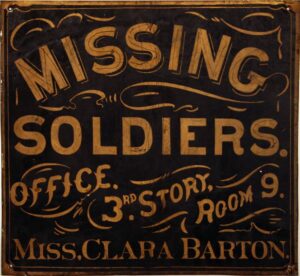
Missing Soldiers Office, Clara Barton Missing Soldiers Office Museum
From 1865 to 1868, Barton and a team of approximately 21 clerks worked from these rooms. According to her 1868 report to Congress, the office had received 63,182 letters, sent out 100,548 letters and forms, distributed 99,057 Rolls of Missing Men, and provided information to the families of more than 21,000 men. The Rolls asked anyone with information to write to 488½ Seventh Street. As the Missing Soldiers Office sign indicated, the office sat at this address on the Third Floor in Room 9. In December 1868, she closed the office, moved away from this boarding house, and briefly moved to Capitol Hill prior to traveling to Europe for the first time. While in Switzerland, she was exposed to the International Red Cross.. Inspired by the organization’s work, she went on to found the American Red Cross in 1881.
In 1870, Washington adopted a new street-numbering system, and 488½ Seventh Street became 437 Seventh Street. That same year, the property was assessed to Samuel Fowler, Susan Ireland’s nephew; Ireland had died in 1869. By 1878 it was assessed to Jane S. Fowler, and it remained in the family into the twentieth century. The building stayed busy. Over the next half century, city directories list a patent agency, booksellers, clothiers, dentists, lawyers, an engraver, and a gas-lamp dealer among its tenants. Upstairs, Edward Shaw remained until 1911, when, in poor health, he left to live on Capitol Hill with loved ones. Between 1913 and 1915, the third floor was sealed off. The commercial spaces below continued to be rented. In 1934, the Boyce & Lewis Shoe Company took over most of the building, using the second floor as a storeroom while the third floor remained mostly vacant.
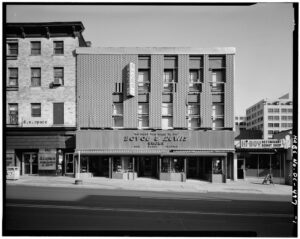
Boyce & Lewis Shoes, Library of Congress
By the 1970s, downtown Washington had changed dramatically, and Congress set out to update the stretch of Pennsylvania Avenue between the White House and the Capitol. The agency it created, the Pennsylvania Avenue Development Corporation, took responsibility for the surrounding blocks, including the block where the Clara Barton Missing Soldiers Office Museum stands today. In 1979, a team from the Historic American Buildings Survey, a federal program that records historic buildings in drawings and photographs, came to document 437 Seventh Street. They found its nineteenth-century front hidden behind a modern aluminum façade, and they were never let upstairs. The façade was removed in the 1980s and the brick front was replaced thereafter. The Boyce & Lewis shoe store moved out in the 1990s. When the Development Corporation was dissolved in 1996, the building passed to the federal government’s General Services Administration. Through all of it, the third-floor rooms where Clara Barton had lived and worked remained out of view. Upstairs, behind the sealed-off third floor, the rooms were still waiting – until GSA carpenter Richard Lyons uncovered the building’s hidden history.
About the Author
Madeleine Thompson is the Site Manager of the Clara Barton Missing Soldiers Office Museum. She holds a BA in Political Science from West Virginia University and a MA in Sexual Dissidence from the University of Sussex.
Tags: Civil War, civil war medicine, Clara Barton, Clara Barton Missing Soldiers Office, DC, Missing Soldiers Office, Nurse, Washington, Washington DC, Women's History Posted in: Uncategorized