A Murder at the Treasury Department
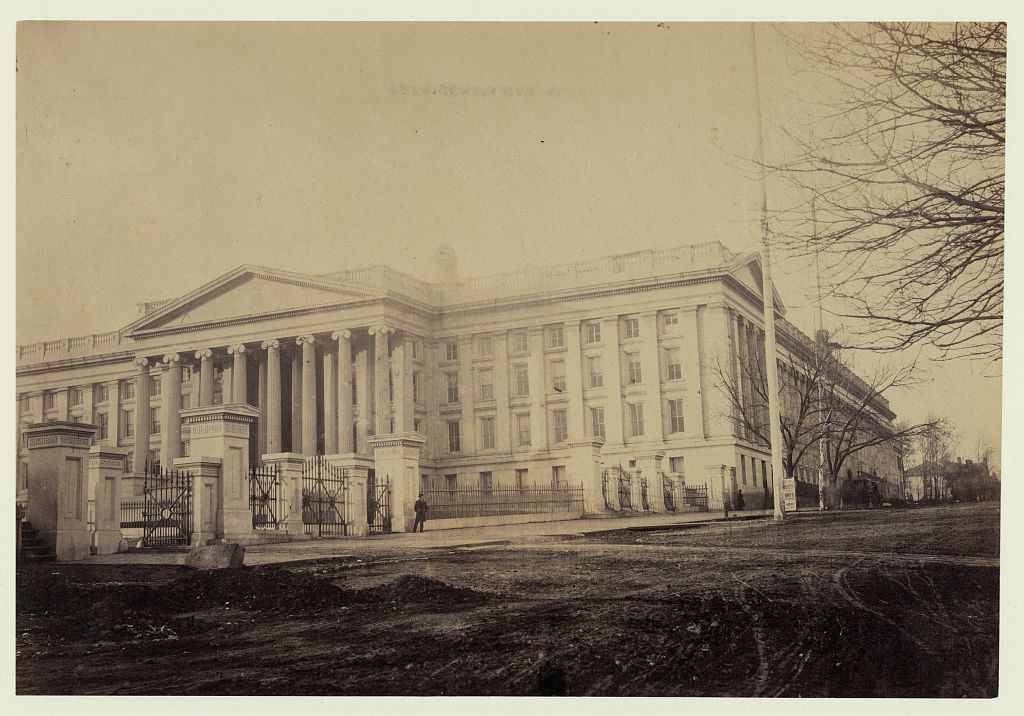
The Treasury Building During the Civil War (Library of Congress)
On January 30, 1865, Washington was abuzz with gossip. A government clerk named Adoniram Burroughs had been shot twice at the Treasury Department. At a time when death was seemingly everywhere due to the war, this incident managed to stand out. A key detail traveled with the story: the killer was a young woman.
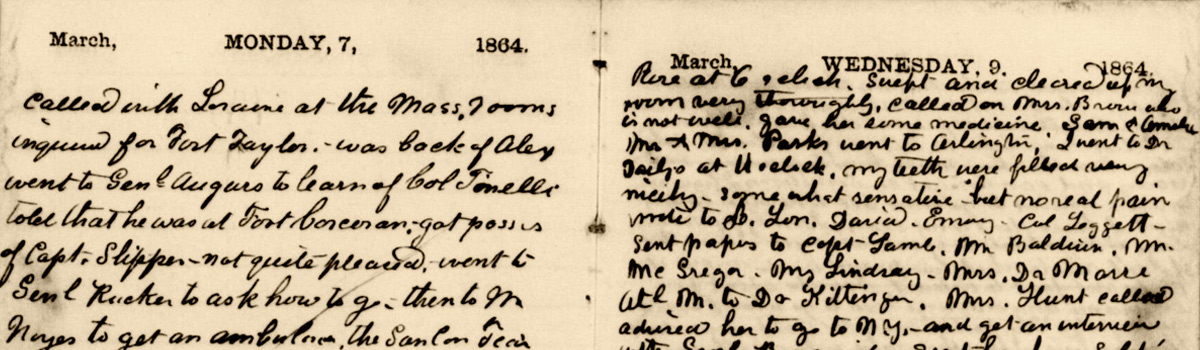
Clara Barton was in town and evidently heard the news. The last line of her diary entry from the day reads:
A Mr. Burroughs shot in the Treasury Building by one Mary Harris, [alleged] breach of promise.
In 1858, Mary Harris met Burroughs in their mutual hometown of Burlington, Iowa. She was 12 and he was 27. She was the daughter of working class Catholic Irish immigrants; he was the son of a wealthy family with deep ties to the Baptist church. Their relationship developed over time. In 1863, Burroughs persuaded Harris to move to Chicago with him by promising to marry her. She stayed with a female acquaintance named Louisa Devlin. Her family found the arrangement disgraceful and disowned her. Soon, Burroughs did too by disappearing to Washington in early 1864 and marrying another woman.
Harris spent months agonizing from the abandonment. Burroughs toyed with her by writing her letters under an alias and even attempted to arrange a covert meeting at a Chicago brothel in September. She did not show up for the rendezvous and sank further into depression after hearing that he allegedly did.
Harris turned to the law for recourse; she hired a lawyer and intended to sue Burroughs for breach of promise in Washington’s courts. She traveled with Louisa to Washington multiple times to start the process. She decided not to wait on a judge. In January 1865, she purchased a pistol and decided to track Burroughs down to deliver justice herself.
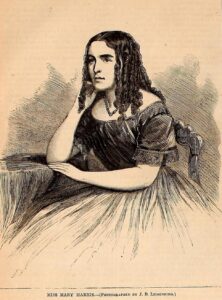
Mary Harris (Wikimedia)
When Mary Harris found her tormentor at his workplace, his last words were “Oh, my God.” She fired two shots. Both hit their target. Burroughs was carried away by coworkers but died within a matter of minutes. Harris waited for the police to arrive. She originally gave the false name of Louise Devlin and a contrived story with a declaration of purity, but confessed with her full truth after being taken away by the police.
Press coverage of the murder soon spread across the country. Even the Richmond Dispatch and other newspapers in the Confederacy picked up the story. Members of Congress visited Harris in prison to check on her. After a couple weeks, the matter faded back into the background as the war carried on.
Harris’s case went to trial in July 1865. The press regained interest and the case received nationwide coverage.
Her defense relied on the concept of paroxysmal insanity. Joseph Bradley, the lead among Harris’s lawyers, claimed that an otherwise upstanding young lady of good character had been driven temporarily insane by the man she killed. Love letters from Burroughs were produced as proof of his seduction and deception. Multiple doctors were called by the prosecution and defense to offer their medical perspectives on Mary’s mental health.
The concept of using delusion or insanity as a defense originated 22 years earlier in England. The case of Daniel M’Naghten’s acquittal on a murder charge due to “monomania” – insanity based on fixation on a single thing – made headlines across the world, particularly in the medical and legal fields, including in America.
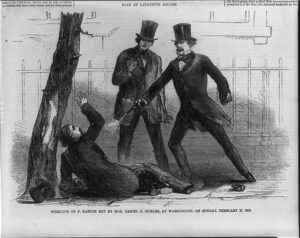
Daniel Sickles killing Phillip Barton Key (Library of Congress)
Washington, D.C. juries had been asked to consider honor and insanity before. In 1856, Harris’s lead lawyer Joseph Bradley, successfully obtained an acquittal for his client Daniel Jarboe for killing John Nally in an unhinged state after he learned Nally had seduced his sister with no intention of marrying her. The most high profile example occurred in 1859 when then-Congressman Daniel Sickles was acquitted after publicly killing his wife Teresa’s lover, District Attorney Phillip Barton Key – who had unsuccessfully served as prosecutor for the Jarboe case, in Lafayette Square.
Find out more about Sickles, his unique case, and the National Museum of Civil War Medicine’s current exhibit:
Mary Harris’s defense also used phrenologists to assess her virtuous character and measure the impact of the emotional injury she suffered. Phrenology, the practice of measuring skulls under the premise that things like character and intellect could be scientifically measured from them, was widely accepted in the 19th century. As a girl, Clara Barton had been assessed by a phrenologist as well, which inspired her first career: teaching.
Mary was ultimately acquitted by a jury on July 19, 1865. The paroxysmal insanity defense worked. Reactions in the press were mixed; critics decried the verdict as giving women a legal precedent to kill. Despite her defense being based on her insanity, Mary was not required any further institutionalization or hospitalization. She lived out the remainder of her life out of the spotlight. She later married her former lawyer Joseph Bradley in 1883.
About the Author
Roy Blumenfeld is a history enthusiast and volunteer docent at the Clara Barton Missing Soldiers Office Museum. He holds a BS in Political Science from Appalachian State University.
Sources
Websites
- Barton, Clara. Clara Barton Papers: Diaries and Journals: 1865, Jan.-Dec. 1865. Library of Congress, www.loc.gov/item/mss119730011/
- “Convicts to be Pardoned. Died. Tragedy in Washington.” Daily Dispatch [Richmond, VA], 6 Feb. 1865, p. 2, dispatch.richmond.edu/1865/2/6/2/11
- Gerber, Isaac W. “Daniel M’Naghten: The Man Who Changed the Law on Insanity.” Psychiatric Times, vol. 39, no. 1, 20 Jan. 2022, www.psychiatrictimes.com/view/daniel-m-naghten-the-man-who-changed-the-law-on-insanity
- “Joseph Habersham Bradley.” Find a Grave, 24 Jan. 2010, www.findagrave.com/memorial/46605697/joseph_habersham-bradley
- Morgan, EmmaLee. Acquitted by Reason of Paroxysmal Insanity? Science and Gender in the Nineteenth-Century Murder Trial of Mary Harris. 2023. University at Albany, State University of New York, Undergraduate Honors Thesis. Scholars Archive, scholarsarchive.library.albany.edu/history_honors/37/
- Pohl, Robert. “Lost Capitol Hill: Daniel W. Jarboe, Murderer, Pt. 3.” The Hill Is Home, 27 Mar. 2017, thehillishome.com/2017/03/lost-capitol-hill-daniel-w-jarboe-murderer-pt-3/
- Thomas, Heather. “Murder in Lafayette Square.” Headlines & Heroes, Library of Congress, 14 Sept. 2022, blogs.loc.gov/headlinesandheroes/2022/09/murder-in-lafayette-square/
- Wilhelm, Robert. “The Harris-Burroughs Affair.” Murder by Gaslight, 31 May 2025, www.murderbygaslight.com/2025/05/the-harris-burroughs-affair.html