A Chance Discovery
It was a rainy day in November 1996, when Richard Lyons was checking a dilapidated building at 437 Seventh Street, NW, that was to be demolished as part of the rehabilitation of the Penn Quarter neighborhood in Washington, D.C. Lyons was an employee of the U. S. General Services Administration (GSA), the branch of the federal government that is responsible for purchasing and for real estate. The building was dark, full of trash and thick dust, and the upper floors had probably not been visited in years.
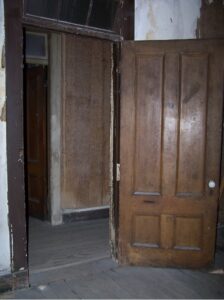
In exploring the third floor of the old boarding house, Lyons thought he heard noises from one of the front rooms but found nothing to explain the sounds. Then, as he put it, he felt “a tap on my shoulder,” thinking it was a co-worker. Turning around he saw he was alone but then looked up and noticed an old envelope hanging from the slats of the decaying ceiling.
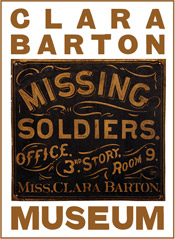
Intrigued, Lyons located a ladder and investigated, discovering a crawlspace full of items dating to the 19th century. The first clue that this was an extremely important trove of artifacts was a small, enameled sign which read, “Missing Soldiers Office, 3rd. Story, Room 9, Miss Clara Barton.”
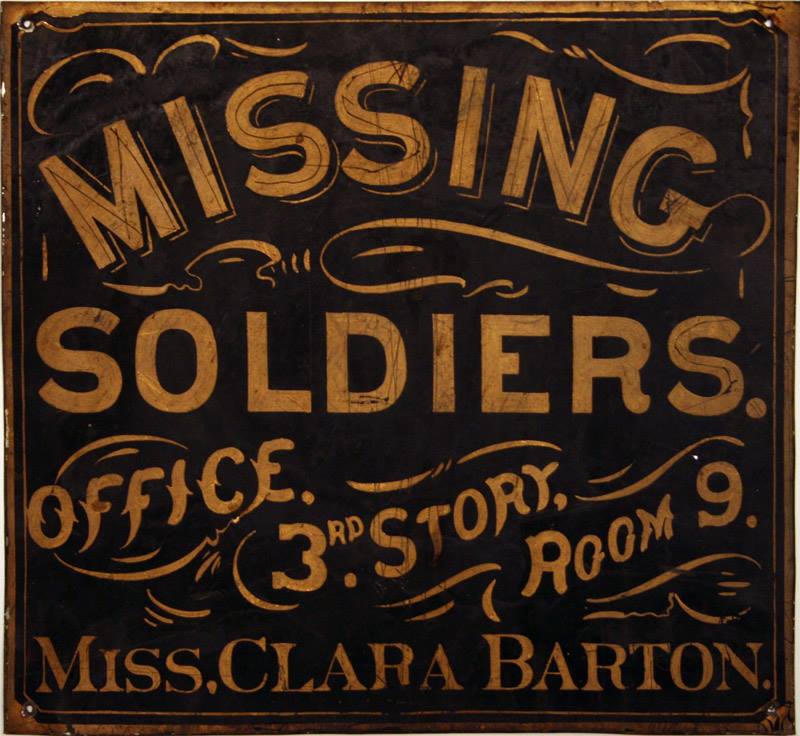
Lyons reported his amazing find, and the process of retrieving the items and ensuring the building was preserved began in earnest. In all, over 2,000 artifacts were recovered from the crawlspace, including Civil War-era newspapers and writing paper, personal items from both Barton and her boarding house neighbors, correspondence and crates addressed to Barton, and a rare, printed “Roll of Missing Men”—one of the publications of the Missing Soldiers Office.
Barton had lived in the building from 1861 to 1869. The rooms doubled as a warehouse for the supplies she collected to give to soldiers, then became home to “The Office of Correspondence with Friends of the Missing Men of the United States,” which was later referred to as the Missing Soldiers Office. The MSO helped determine the fate of nearly 22,000 missing Civil War soldiers.
It is remarkable that many items tied directly to Barton still survive, both in the collection of artifacts and in the space itself. The number “9” is still painted on the door to one of the rooms, near a mail slot that Barton paid 50 cents to have cut into the wood so that letters could be dropped off for the office. The partition she put up to enclose her own small bedroom remains, as do fragments of wallpaper she personally picked out and applied. The stairs to the third floor are original, so visitors can walk in Barton’s footsteps. Everyday household items like brooms, hairbrushes, fountain pens and ink bottles, slippers, and fixtures for gas lighting were among the artifacts found on the site. It is surmised that her boarding house neighbor, Edward Shaw, placed all the items in the crawlspace when Barton moved out in late December of 1868.
Once the site was identified, the process began to restore the third floor to its 1860s appearance, complete with re-creations of the wallpaper styles found at the site and the simulation of gas lighting using the old fixtures as reference. Modern amenities were added to allow the space to function as a museum, and the first floor was outfitted as a small visitor center and store.
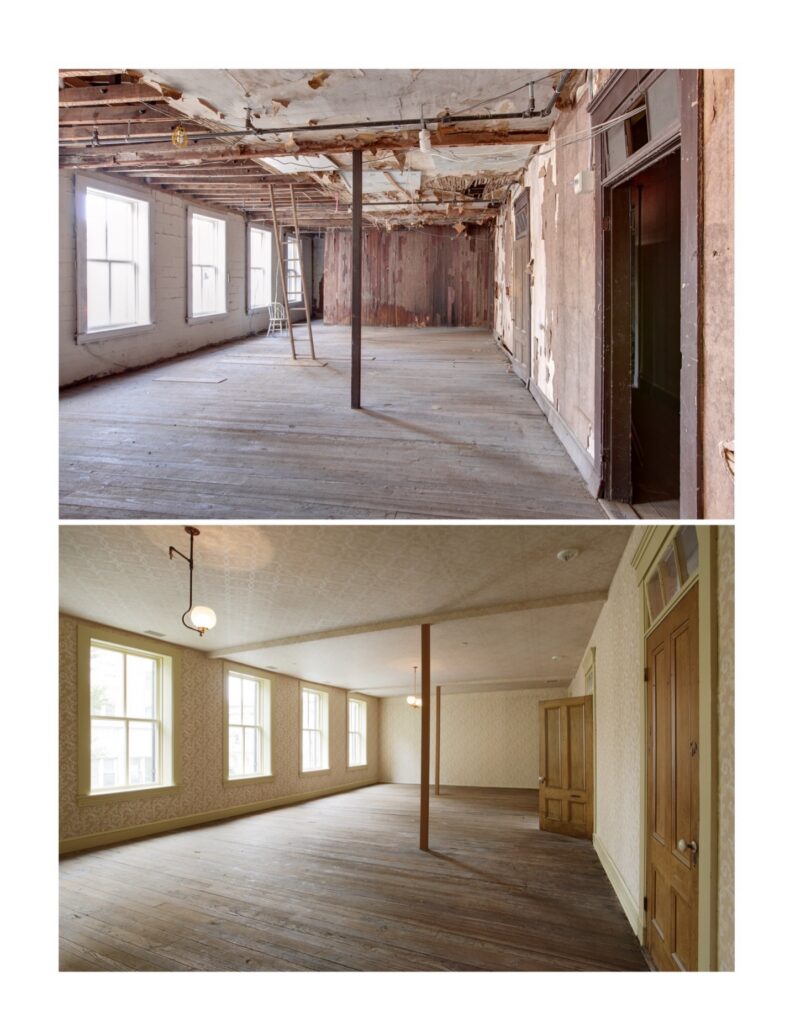
On July 28, 2015, the Clara Barton Missing Soldiers Office Museum (CBMSO) was officially opened, 154 years after Clara Barton had moved into an unassuming apartment on 7th Street in Washington, D.C.. The CBMSO is the result of a long-term project which was made possible through a one-of-a-kind public/private partnership between the National Museum of Civil War Medicine and the GSA. Today, the CBMSO tells the story of Barton, her incredible work both during and after the Civil War, and the impact she continues to have on the world today.
About the Author
Terry Reimer is the Director of Research the National Museum of Civil War Medicine in Frederick, MD. Prior work includes experience in historical archaeology and research, specializing in 17th, 18th, and 19th century American sites. Reimer is the author of three books on Civil War medical history including One Vast Hospital, co-author of two more, and the editor of Clara Barton: Civil War Humanitarian.
Tags: Civil War, Civil War nurses, Clara Barton, Clara Barton Missing Soldiers Office, DC, Missing Soldiers Office, Washington, Washington DC, Women's History Posted in: Uncategorized