Missing Soldier Spotlight: David C. Hickey
The Washington Monument rises prominently above the city of Washington, D.C., serving as a distinguished landmark known around the world. Although the Washington Monument is no longer the tallest structure globally—having once held that distinction at 555 feet—it continues to be recognized as the tallest free-standing stone structure in the world.
Visitors from around the world who come to Washington, D.C. are afforded spectacular panoramic views of the city from the monument’s observation area. Beyond these vistas, those who enter the Washington Monument discover a wealth of historical and artistic detail within its interior, including an Egyptian-inspired motif, commemorative stones, and authentic Civil War-era graffiti.
Among the notable pieces of graffiti found within the Washington Monument is a profile sketch believed to be of George Washington. Beneath this profile sketch is the bold inscription of D.C. Hickey, the likely artist, and…one of Clara Barton’s missing soldiers.
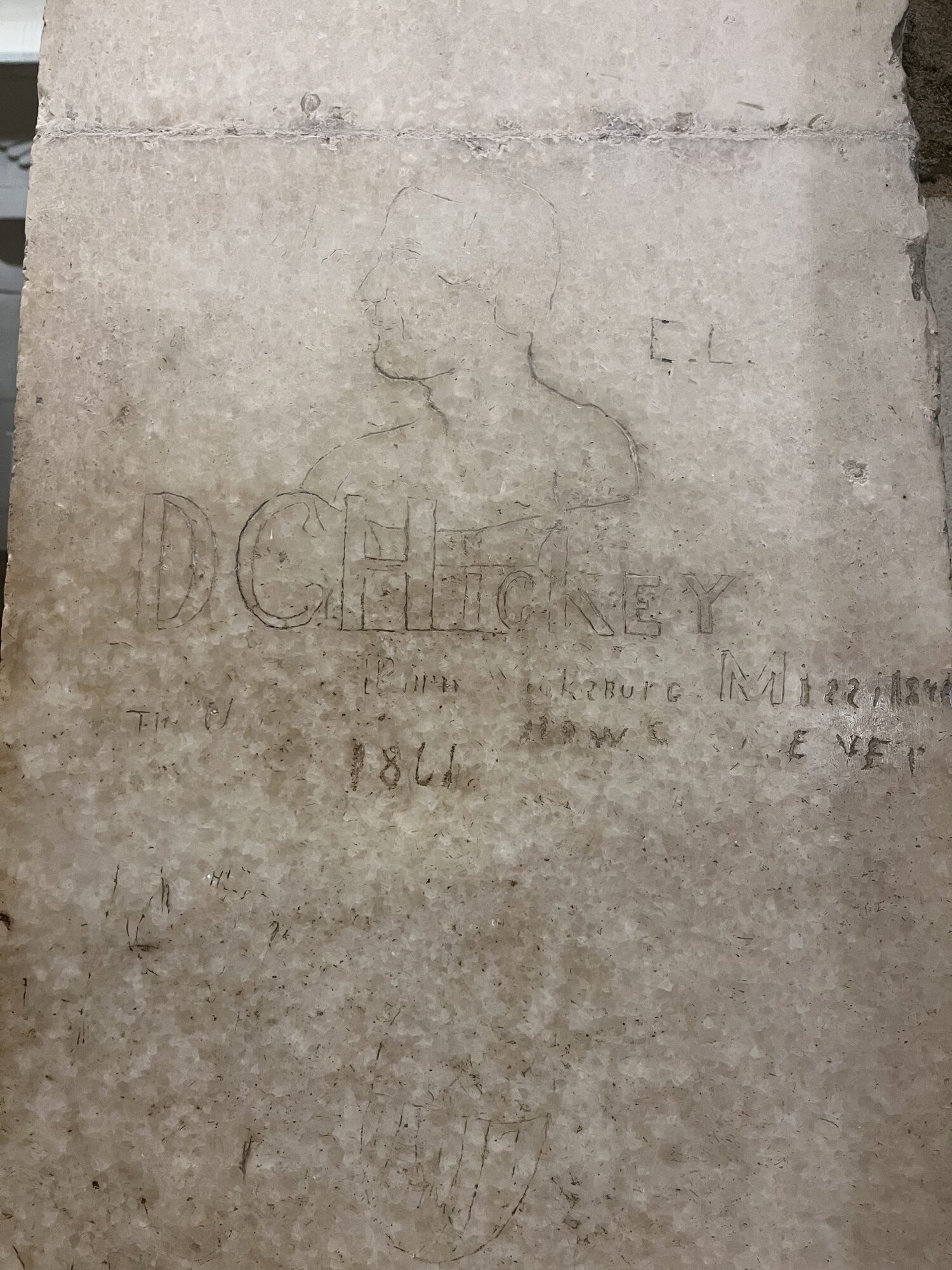
D.C. Hickey carving inside the Washington Monument (photo by Jason Campbell)
David C. Hickey enlisted in Company C of the Third Pennsylvania Cavalry on August 22, 1861, committing to a three-year term of service. The Third Pennsylvania Cavalry was mustered into federal service in August 1861 in Philadelphia, Pennsylvania, and initially, the regiment bore the name Young’s Light Kentucky Cavalry named after its first commander Colonel William Young. The peculiar decision to name a Pennsylvania cavalry unit after Kentucky was intended to encourage the Commonwealth of Kentucky to remain loyal to the Union. After its redesignation as a Pennsylvania regiment, it was renamed the Third Pennsylvania Cavalry.
In August 1861, the Third Pennsylvania Cavalry was organized at “Camp Park,” located within Washington Park on 7th Street, north of Washington, D.C. The regiment undertook intensive training and drill exercises in preparation for military service, with George Armstrong Custer serving as one of its training officers. During this period in Washington, Private David C. Hickey carved his historic graffiti into the wall of the Washington Monument, leaving a lasting testament to his presence.
The Third Pennsylvania Cavalry participated in several significant engagements during the Civil War, including the Battles of Antietam and Gettysburg. During the Battle of the Wilderness, Private David C. Hickey was taken prisoner and subsequently transferred to Andersonville Prison. Hickey ultimately died from scorbutus, commonly known as scurvy, a disease resulting from the deficiency of vitamin C.

History of the Pennsylvania Volunteers 1861- 1865, by Samuel Bates, pg. 379 (University of Michigan Library). Note: Bates records Hickey’s death as August 10; however, Atwater recorded Hickey’s death as August 11.
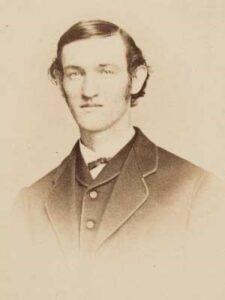
Dorence Atwater (Connecticut State Library)
Thousands of federal prisoners died within the prison walls of Andersonville due to malnutrition and starvation. Sadly, when these soldiers perished within the confines of Andersonville, their remains were interred in unmarked mass burial trenches, lacking any headboards or identification. Fortunately, however, Dorence Atwater, who was himself incarcerated and previously served as a clerk known for his exemplary penmanship, meticulously maintained a covert record of federal deaths and their corresponding burial sites.
During his imprisonment at Andersonville, Atwater was recognized by Confederate Surgeon Isaiah H. White, who assigned him the responsibility of maintaining the official register of deaths. The task was daunting, as Federal soldiers were succumbing at a rate of approximately fifty per day. General Orlando Willcox speaking on the fate of Federal soldiers held as prisoners, “…for to be taken prisoner now is only another term for murder by inches. How long have our noble braves got to endure this torture from those fiends in human form?” For each deceased individual, Atwater meticulously documented the surname, first initial, regiment, company, and grave site location—averaging one entry every six minutes.

Atwater, Dorence’s A List of the Union Soldiers Buried at Andersonville. Copied from the Official Record in the Surgeon’s Office at Andersonville (New York: Tribune Association, 1866)
In addition to the official record, Atwater discreetly compiled a duplicate list, which he concealed within the lining of his coat. Each night, upon returning to the main camp, he ensured the clandestine list remained hidden from the guards. Atwater continued to perform his duties with diligence until February 27, 1865, when he and thousands of other Federal prisoners were formally transferred back to Federal authorities.
Upon returning to the Federal lines, Atwater encountered further obstacles. The War Department sought to seize his confidential records documenting federal fatalities at Andersonville. Nevertheless, Atwater aimed to disseminate these lists to inform families who were searching for lost relatives. In the summer of 1865, Atwater successfully arrived in Washington, where he sought the aid of Clara Barton. Atwater and Barton jointly departed Washington to join an Army expedition to Andersonville with the purpose of identifying missing soldiers. As a result of their work, nearly 13,000 previously unmarked graves—including that of David Hickey—were identified, bringing the total recognized graves at Andersonville to approximately 95%.
Atwater, speaking to the families of lost soldiers stated:
This Record was originally copied for you because I feared that neither you nor the Government of the United States would ever otherwise learn the fate of your loved ones whom I saw daily dying before me. I could do nothing for them, but I resolved that I would at least try to let you sometime know when and how they died. This at last I am now able to do.
Today, Hickey’s grave is marked due to the collaborative work of Atwater and Barton. Barton continued to pursue her objective to identify as many missing soldiers as possible from the war by founding the Missing Soldiers Office. Atwater was among several clerks who tirelessly contributed to the committed work performed within this office.
About the Author
Jason Campbell, a graduate of Hagerstown Community College and Hood College, is a battlefield guide and former park ranger at Antietam National Battlefield. Jason remains committed to historical interpretation and public service with the National Park Service, serving as a park ranger at the National Mall and Memorial Parks. He has contributed to the Antietam Institute publications The Brigades of Antietam and The Commanders of Antietam.
Tags: Andersonville, Civil War, Clara Barton, DC, Missing soldiers, Missing Soldiers Office, Washington, Washington DC Posted in: Uncategorized