Safe Haven: Clara Barton and the Pratt Street Riot Victims
In 1861, anti-recruitment riots in Baltimore marked a key moment in the Civil War. Tensions were high as Lincoln’s call for 75,000 volunteers angered Southern sympathizers, especially in divided states like Maryland. When the 6th Massachusetts Infantry arrived in Baltimore, they were attacked by an agitated mob. In self-defense, the soldiers fired back, resulting in the first deaths of the Civil War and numerous injuries. As their train pulled into Washington, D.C., Clara Barton, working at the U.S. Patent Office, rushed to the scene to help. After treating these familiar wounded men, she expanded her humanitarian work to assist all Union soldiers – marking the beginning of her career as the “Angel of the Battlefield.” This event was pivotal in shaping her enduring legacy of caring for soldiers during the Civil War.
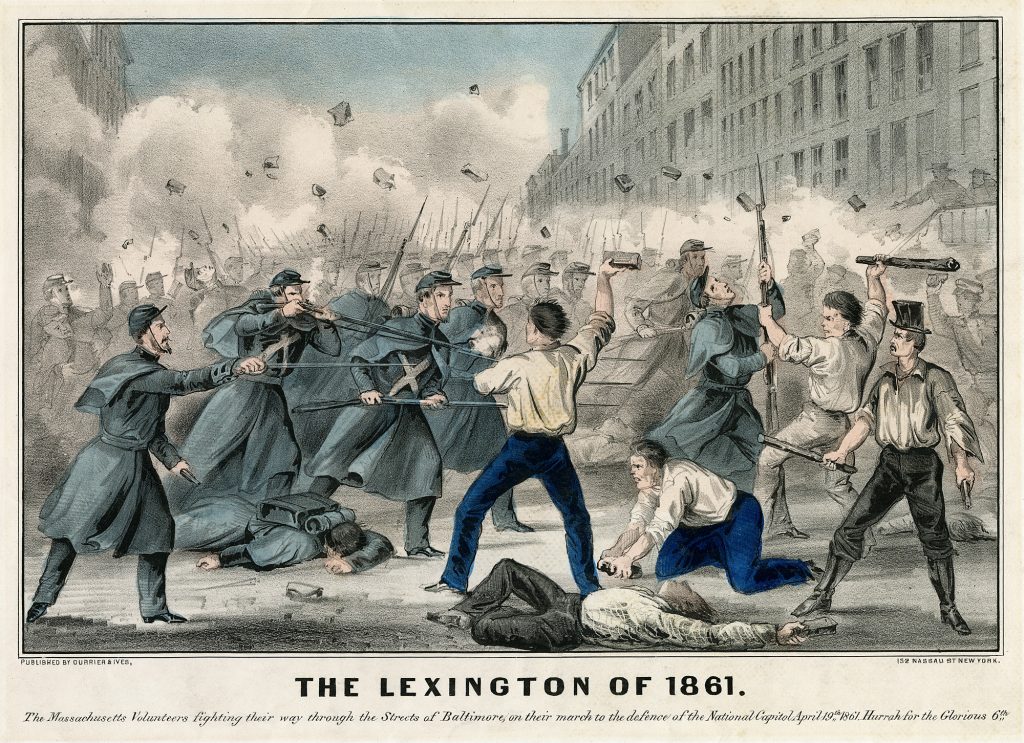
Photo Source: Williams College[1]
April 19th is a significant date in our nation’s history. It marks newsworthy events across eras and conflicts, including the “shot heard ‘round the world” at Lexington and Concord (1775), President Lincoln’s funeral at the White House (1865), and the tragic Oklahoma City Bombing (1995). Adding to the list of occurrences on this day was the 1861 orchestrated anti-recruitment attack on Union soldiers and the first deaths of the Civil War in Baltimore, Maryland. For many pro-Secessionist citizens in the city and across the divided country, this particular April 19th incident signified collective rebellion against Lincoln’s presidency and the desire of Southern states to ratify their own Orders of Secession. For Clara Barton, receiving the wounded in Washington, these attacks were personal and launched her into a life of public work.
Lincoln’s call for 75,000 volunteers rang-out in the wake of the bombardment of Fort Sumter. Among those who answered, many enlisted out of a sense of duty or to fulfill notions of glory and honor. The President’s desires to bolster Union numbers agitated and inflamed anti-Northern attitudes in the South. Border states that had a significant population of enslaved labor, such as Maryland, were divided on the topic of secession. Permitting Union troops to use Maryland rails was a sensitive matter. By allowing troops to pass through Maryland to conduct Lincoln’s orders, many secessionist Baltimoreans believed themselves to be complicit in the North’s suppression of “Southern rights.”
On April 19, 1861, the 6th Massachusetts Infantry arrived at a hornet’s nest of upheaval in Baltimore. A gap in the rails required passengers to change trains once they disembarked at President Street Station and reboard at the Camden Station to continue on the route to Washington, D.C. Secessionist citizens who did not want Union soldiers using their city as a throughway took matters into their own hands. A mob quickly assembled with pistols, rifles, and rebel flags in hand and attacked the soldiers. In response, several soldiers fired into the mob and a brawl ensued.
Four soldiers lay dead near the Baltimore tracks and thirty-six were wounded. Word spread of their ordeal as the train cars rolled into Washington’s B&O station. Three majors newspapers of the day – The Evening Star, Alexandria Gazette, and National Republican – printed harrowing accounts of the assaults’ timeline. Among those who rose to the occasion and treated the remaining attack victims was Clara Barton. Working at the U.S. Patent Office when word of the troops spread around Washington, Barton and her sister Sally rushed to the depot along with a growing crowd of anxious onlookers. Most of the capital city learned of the incident moments after the fight had erupted on Pratt Street. Barton herself recounted the moment she laid eyes upon the young men in blue descending from the rail cars – she recognized several as the boys who grew up in the same Worcester County, Massachisetts, of her youth.
Initially, the 6th Massachusetts were housed in the Senate chambers that had been converted into temporary barracks for newly-recruited soldiers. Washington had not yet transformed into the military center that it would become, creating a want of housing and supplies for newcomers. At the chambers, Barton located her compatriots in this large, makeshift base and frequently checked on their well-being. The Evening Star reported on April 20 that “all of above [named wounded soldiers] except Capt. Dyke are at the Washington Infirmary.” While under the care and supervision of their regimental surgeon and Dr. J.S. Smith of the D.C. Volunteers, the paper noted that “many citizens of this place rendered their assistance in taking them there.”[2] The Washington Infirmary was a teaching center at Columbia College, which would later become George Washington University, and was not requisitioned for official military use until May 1861. It burned down in November 1861 and the Judiciary Square Hospital was built in its stead.[3] It is not clear how many of the 6th Massachusetts were relocated there and how many remained at the Senate in better health thanks to Barton’s care.
The Infirmary was located near Clara Barton’s boarding House on 7th Street, where she began to collect supplies for her hometown wounded. Her experience tending to the Pratt Street riot victims is often considered the catalyst for her humanitarian career. Barton will expand her mission from the members of the 6th Infantry to all Union soldiers in need of her help. The “Angel of the Battlefield” did not turn her back on the injured and diseased “boys in blue,” and continued to operate in the Washington scene while also venturing to faraway battlefields to lend a hand.
About the Author
Madeline Feierstein is an Alexandria, VA, historian and founder of the educational and historical consulting company Rooted in Place, LLC. A native of Washington, D.C., her work has been showcased across the Capital Region. Madeline is a writer for Emerging Civil War and the National Museum of Civil War Medicine. She leads significant projects to document the sick, injured, and imprisoned soldiers that passed through Civil War Alexandria. Madeline holds a Bachelor of Science in Criminology from George Mason University and a Master’s in American History from Southern New Hampshire University. Explore her research at www.madelinefeierstein.com.
Sources
[1] Currier & Ives, The Lexington of 1861, 1861, Williams College, 1861, https://library.williams.edu/files/2021/04/Graphics-0158_1-1024×743.jpg.
[2] “The Massachusetts Volunteers Arrive Here,” The Evening Star, April 20, 1861, https://chroniclingamerica.loc.gov/lccn/sn83045462/1861-04-20/ed-1/seq-3/.
[3] “Historic Medical Sites in Downtown Washington DC,” National Library of Medicine, n.d., https://www.nlm.nih.gov/hmd/historic-medical-sites/downtown-sites.html#jump6.
Tags: Civil War, civil war medicine, Civil War nurses, Clara Barton, Clara Barton Missing Soldiers Office, Washington, Washington DC Posted in: Uncategorized