Missing Soldier Spotlight: William P. Burgess
Burgess Wm. P from the 36th Illinois Infantry’s entry stands out against the many names listed on the Rolls of Missing Men collected by Clara Barton – his entry includes a unique note: “drummer boy.” This spurred an investigation into the role of musicians in Civil War communication, culture, and medical care.
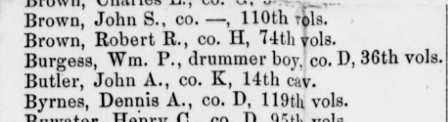
Roll of Missing Men No. 3 (Library of Congress)
William P. Burgess had brown hair and brown eyes and stood 5 feet 2 inches tall when he enlisted in Company D of the 36th Illinois Infantry on August 20, 1861. He claimed to be 19 years old. His brother, Benjamin, also enrolled in the 36th Illinois. A little more than three years into William’s service, Burgess was taken prisoner at the Battle of Chickamauga in Georgia on September 20th, 1863. According to records, he was held as a prisoner of war at Andersonville until being paroled on February 24, 1865. On March 4, 1865, he was admitted to a general hospital in Wheeling, WV, with typhoid fever. He died of the disease on March 12, 1865.
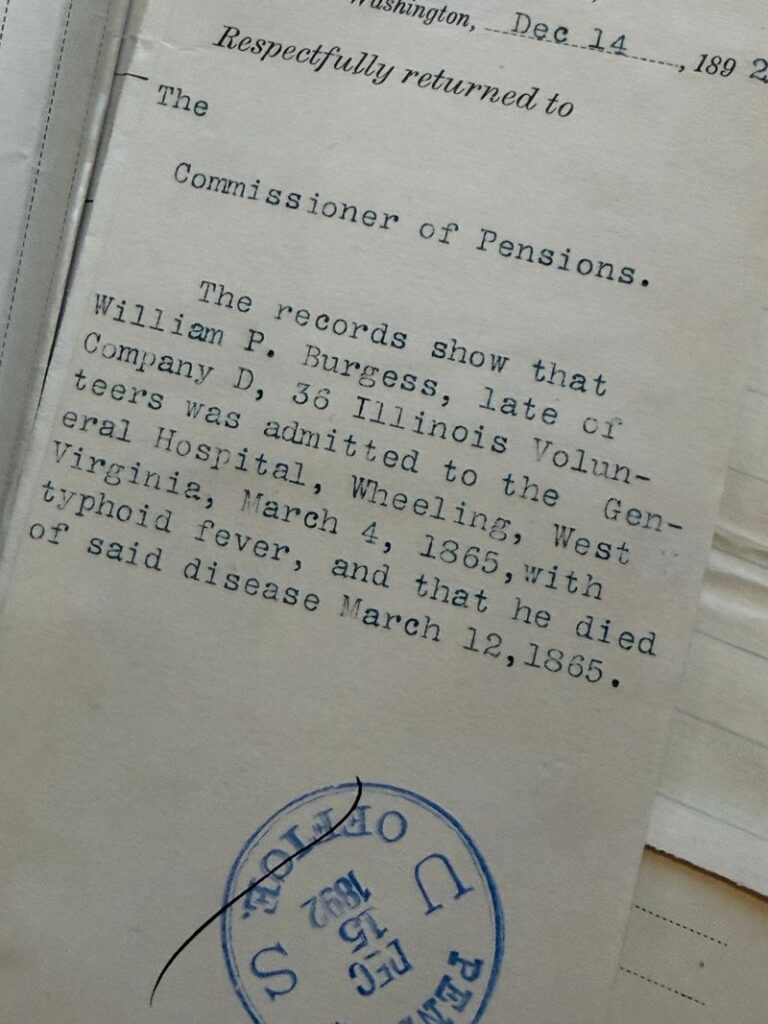
William P. Burgess Pension File (National Archives)
It was common to find drummer boys who had lied about their age to qualify for enlistment. Many famous drummers including John Clem and Robert Hendershot were much younger than the average muster age of 18. Whether William Burgess truly was 19 or altered his age to be able to join the war effort is unknown.
The 36th Illinois Infantry fought in the Western theater of the Civil War, including at Pea Ridge, Perryville, and Stones River before the Battle of Chickamauga. At the Battle of Chickamauga, Burgess was one of two Company D members taken prisoner and brought to Andersonville. Because his name can be found on the 3rd edition of Clara Barton’s Rolls of Missing Men out of the Missing Soldiers Office, we know that someone was looking for him after the war. We have no correspondence of Barton informing the information seeker about William’s death, but his father, also named Benjamin Burgess, later filed for and received a dependent pension. After his father’s death, William’s brother Benjamin who had also served in the 36th Illinois, filed for his father’s funeral and burial expenses to be paid for with funds disbursed from the pension.
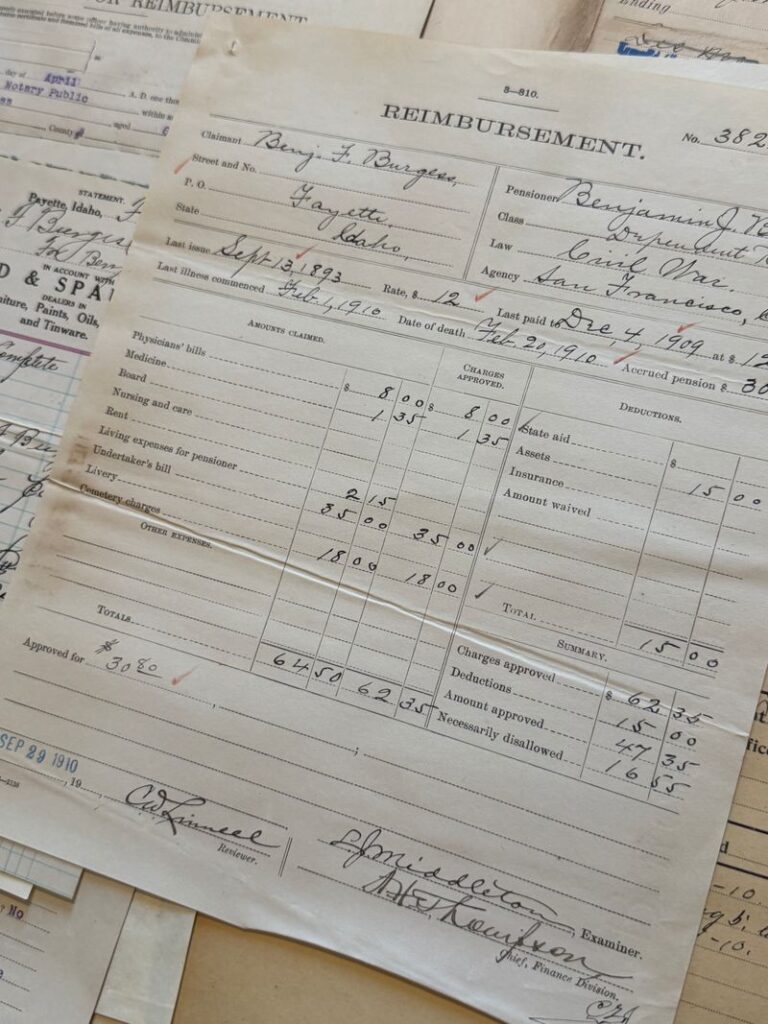
William P. Burgess Pension File (National Archives)
As a drummer boy, William Burgess would have been responsible for a wide variety of tasks on and off the battlefield. The most important job for any drummer boy was using the beat of his drum to communicate orders with his company members.
The beat of drums has accompanied warfare for centuries. In Ancient Rome, drums were also important tools for coordination and communication in military operations, allowing commanders to easily give orders to large groups. They took on a similar role in the Civil War. The drummer boy’s music not only facilitated communication, but also provided a morale boost and entertainment.
During the Civil War, each company was usually outfitted with two musicians, thus a regiment would have a full band. Company D of the 36th Illinois had two men listed as “musician” or in this case, “drummer boy.” William Burgess was joined by Henry T Kellum, who was born in Vermont and enlisted in 1861 as a musician.
Drummer boys learned 26 different rudiments, or rhythms, all with their own meaning. Some learned them from the School of Practice located at Fort Collins in New York, the location of the U.S. Army’s institute for musical training. The vast majority of drummer boys learned on the job from other musicians or simply from hearing rudiments from other companies. The most common rudiments to be heard on the battlefield included the long roll which signaled attack or advance. At camp the reveille indicated it was time to get up in the morning. Rudiments used during the Civil War are still used today and can be heard from modern percussion players around the world.
During battle, after signaling to soldiers when to march, charge, or fire, drummer boys often pulled toward the back of the fighting to stay out of harm’s way. The roles they would then fill varied greatly depending on need and personal gusto. Some would act as medical assistants and stretcher carriers, transporting wounded men from the battleground to nearby field hospitals. Others would trade their drums for discarded rifles and join right in on the frontlines. Once the battle was over, it was often drummer boys who would search the battleground for the dead and carry them to their burial locations.
At camp, drummer boys took on a wide variety of roles. Some served as personal aides to higher-ups delivering messages and running errands. Others helped out with cooking and cleaning and taking care of the horses. One drummer boy at each camp was tasked with signaling nightfall with taps, he would stay up through the night to awaken his fellow soldiers at daybreak with reveille.
Drummer boys impacted nearly every aspect of warfare.
About the Author
Maren Gibb is part of the Guest Services Team at the Clara Barton Missing Soldiers Office Museum. She received her Bachelor of Arts from William & Mary in History with a minor in Anthropology and certificate in Public History and Material Culture from the National Institute of American History and Democracy. While at William & Mary, she served as a tour guide at the Sir Christopher Wren Building.
Sources
Aubrecht, Micheal. “A History of Civil War Drummer Boys.” Emerging Civil War, 2016. https://emergingcivilwar.com/2016/07/27/a-history-of-civil-war-drummer-boys-part-1/
Ancestry.com
Joubert, Stephan. “A Breif History of Drums: From Ancient Times to Modern Era.” London Drum Institute, 2024. https://londondruminstitute.co.uk/history-of-drums/
Salazar, Neil. “Drumming Youths: The Practical and Symbolic Value of Drummer Boys to the Union Cause.” John L. Nau III Center for Civil War History. University of Virginia (2023) https://naucenter.as.virginia.edu/blog-page/drumming-youths-practical-and-symbolic-value-drummer-boys-union-cause
Schuette, William, and Myrna L Armstrong. “Civil War Drummer Boys: Musicians, Messengers, and Medical Assistants.” Military Medicine 184, no. 1/2 (2019): 1–4. https://doi.org/10.1093/milmed/usy258.
Posted in: Uncategorized