Missing Soldier Spotlight: Hospital Steward Gustavus Bubenzer
“G. Bubenzer” was added to Clara Barton’s “Roll of Missing Men” with only #6647 and “Hospital Steward” in his listing. It may seem odd that a hospital worker would go missing. It’s often the combat soldiers and field staff that disappear – or the wounded left unaccounted for during muster. Was it an act of desertion? Was he taken prisoner and perished?
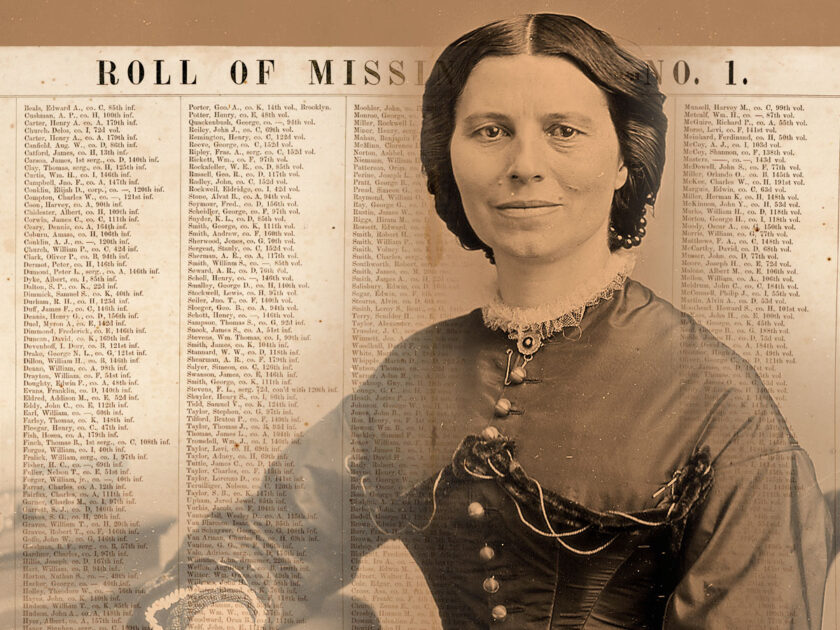
(Library of Congress/Design by Ron Coddington)
Like many Civil War soldiers, Bubenzer immigrated from the German states in 1848 with his parents and four younger siblings. Sailing from Antwerp at age 8, they arrived in New Orleans on the Johann Schmidt.
Gustavus Bubenzer enlisted in March 1863 with Company B of the 13th New York Cavalry. Living in New York City at the time, he was both a medical student and a schoolteacher. His enrollment at Miami University in Ohio in 1856, at just sixteen years old, suggests a precocious intellect and a deep, early commitment to education.
Not much is known of his wartime service as a private in the 13th New York. He received an honorable discharge for unknown reasons in February 1864. By May, Special Orders 68 transferred him to work as a hospital steward in Vienna, Virginia. It is unclear whether he furloughed before re-enlisting, but this position change likely occurred in the field. Was he influenced by the carnage he saw and desired to help his fallen brothers-in-arms? Or did he see a better use of his medical training in a time of war? Most likely both.
In a letter dated July 15, 1864, Bubenzer informs the Medical Director of the West, Dr. James Van Zandt Blaney, that he had been captured on July 3 in Martinsburg, West Virginia, where he was stationed to assist the surgeon in charge. He was paroled the next day.
“Will you please inform me in regard to this parole being binding,” he wrote. “If it is I would respectfully solicit your aid in obtaining leave for me to attend medical lectures in New York City until regularly exchanged.” 1
While we don’t have Dr. Blaney’s response, Gustavus did transfer out of West Virginia. His brief imprisonment could have inspired him to move further away from the front lines.
An October 1864 letter posted from a field hospital in Sandy Hook, Maryland, Bubenzer wrote to Adjutant General Robert Williams for reassignment. In his own words, he was incorrectly “led to believe” by the Provost Marshal of Frederick that the city or county would purchase his $350 bounty. They would not.
“In consideration of these facts I respectfully submit this to your kind consideration, and ask that my assignment may be changed to Ward No. (5) five, Baltimore City, Baltimore County Maryland,” he wrote.2
We can see evidence of a desire to return home, which may have muddied matters for Gustavus.
That October letter was the final piece in Gustavus’ wartime paper trail. A miscommunication likely occurred in the final months of the war. Did he go to Baltimore on his own, or did he decide to attend those lectures back home after all? We can imagine that there was confusion pertaining to his whereabouts, especially if Bubenzer was keen on being useful, needed, or where the action was.
Bubenzer was not lost for long. Records show him in Indiana for his March 1866 marriage to 16-year-old Mary Belle Hall. The couple had two daughters, Else, born in 1871, and Mildred, born in 1877, before his death in 1882 and Mary’s in 1891. Gustavus’s headstone at the Lamb Cemetery in Rome, Indiana displays a Freemason symbol – shedding some light on his post-war interests and identity.
About the Author
Madeline Feierstein is an Alexandria, VA historian specializing in psychiatric institutions, military hospitals, and prisons. A native of Washington, D.C., her work has been showcased across the Capital Region. Madeline is the founder of Rooted in Place, LLC, a project dedicated to telling stories of historic sites and people once bound to them. She continues to lead efforts to document the sick, injured, and imprisoned soldiers that passed through Civil War Alexandria. Additionally, she supports the National Museum of Civil War Medicine. Madeline holds a Bachelor of Science in Criminology from George Mason University and a Master’s in American History from Southern New Hampshire University. Explore her research at www.madelinefeierstein.com.
Sources
1 Bubenzer, Gustavus (B1120), US, Letters Received by the Adjutant General, 1861-1870, National Archives (ID: 300368), accessed on Fold3, https://www.fold3.com/image/300717910/bubenzer-gustavus-b1120-page-1-us-letters-received-by-the-adjutant-general-1861-1870.
2 Bubenzer, Gustavus (B1314), US, Letters Received by the Adjutant General, 1861-1870, National Archives (ID: 300368), accessed on Fold3, https://www.fold3.com/image/300721839/bubenzer-gustavus-b1364-page-1-us-letters-received-by-the-adjutant-general-1861-1870.
Posted in: Uncategorized