Aftermath of the Storm: Clara Barton on the Lecture Circuit
The end of the Civil War brought an end to the dangers Clara Barton faced as a volunteer army nurse, but it did not bring an end to her work. In March 1865, with the support of President Lincoln, she accomplished the monumental task of establishing the Missing Soldiers Office—just weeks before his assassination. Yet the transition from caring for wounded soldiers to searching for the tens of thousands still missing proved a difficult one. Despite securing federal funding by early 1866, Clara Barton needed more money to fund the endeavor.
As a now, well-known national personality, Clara often took to the national lyceum circuit from 1866 to 1868 to earn extra money. She crisscrossed the country by rail, boat, and buggy to deliver gripping lectures about her wartime experiences. Her speaking fees helped keep the gas-powered lights on at her underfunded Washington, D.C. boarding house-turned-office.
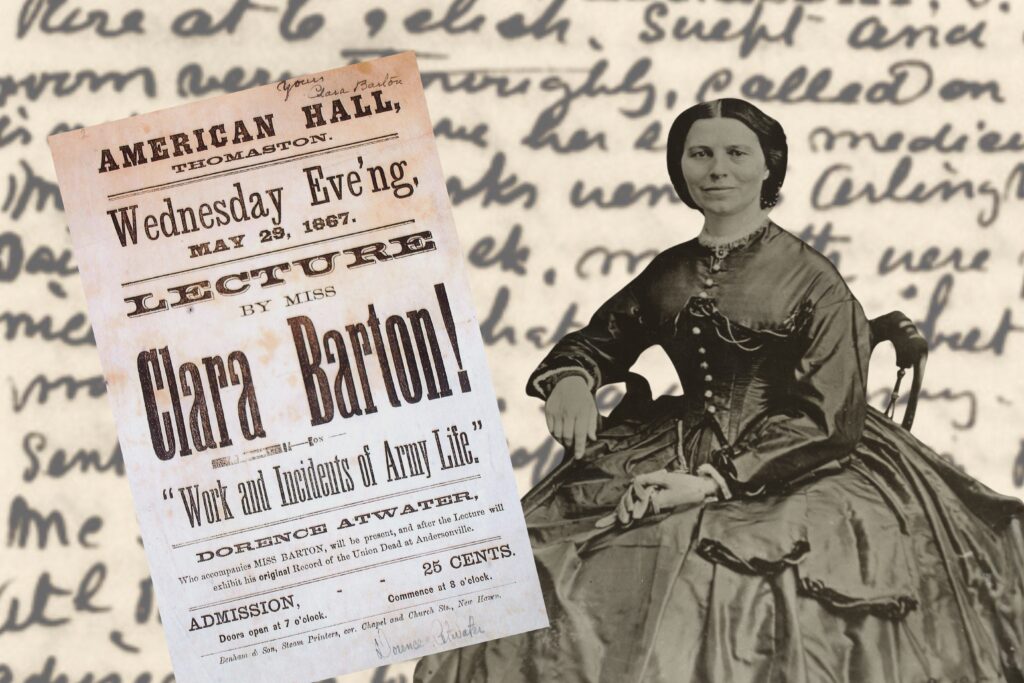
(Library of Congress/Design by Melissa Winn)
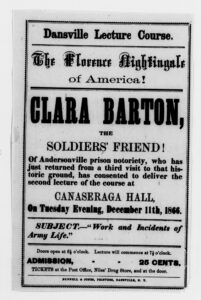
(Library of Congress)
In early 1866, Clara embarked on such a tour. Crowds eagerly awaited a chance to see and hear from the famed “Angel of the Battlefield.” Some of the members of the crowd were veterans who Clara personally had cared for. One ex-soldier arrived with his young daughter. He claimed Clara had cared for him three times over the course of the war: after he had been shot at the Battle of Second Bull Run in August 1862, again after the Battle of Fredericksburg in December 1862, and for a third time near the end of the war when he was ill during the Siege of Petersburg.
An account of the meeting was written in Clara’s diary:
I followed and hasten upon of a witness of the charged greetings which met her on every side hand – presently a man with a light blue soldier coat – with a little child encircled by his arm appeared with limping gate and stood upon one end of the platform –
The soldier told Clara about their two 1862 encounters before moving on.
…one terribly hot [day] in front of Petersburg from over marching nearly our whole [unit] fell with exhaustion and sun stroke. I among the [rest] first for I hadnt the strength I had at Bull Run – and while I lay there on the ground you came with whisky and water for us all and had me return to the hospital tents and you [?] my head in ice and I was too crazy to tell you that I knew you but I did – and your care then saved my life –
Apparently relieved that his painful cataloge had found an end, [Clara]….patting the cheek of the little child, asked and is this your little girl – – yes he replied and passing his hand from proutly over her flown ringlets and drawing her loyaly to hims he added hesitantly – yes she is almost three years old and he [named] her Clara Barton.
On this speaking tour of the Midwest, Clara also unknowingly found herself passing through a very different scene of chaotic destruction.
On March 20, 1866, a massive storm system spawned multiple tornados across several states, from Decatur, Illinois through Indiana. Bad weather continued throughout March.
The regional press covered the story.
CHICAGO, April 2, 1866
A terrible tornado swept over parts of Illinois, and Indiana, on the 20th, the details of which have just come to hand. It seems that it first appeared in Johnson county, in the extreme southern portion of Illinois, and proceeded north about one hundred miles to Douglas county, and thence east fifty miles, to Montgomery, Indiana, where it disappeared, leaving a track of desolation three hundred yards wide. The totals loss of life is estimated at from sixty to one hundred, including entire families from five to nine persons. Houses, trees, and cattle were taken up bodily, and heavy articles which have been recognized, have been carried twenty miles.
Clara wrote about what she saw from her train window in her diary:
FRIDAY, MARCH 30, 1866
During the late storm of Thursday and Friday, On the slope tracks. For the north [left] [*was about east] Decatur Ill on the Ill Central R-ow-
The last car was thrown from the track, by the spreading of the rails and [thorough] plunged down an embankment and dragged.
The destruction caused by forces of nature must have looked very familiar to individuals like Clara who had witnessed similar scenes after armies clashed between 1861-1865.
Yet, unlike the battlefield where military medical corps controlled the carnage, civilian infrastructure offered no centralized emergency system. When a train derailed or a town was flattened by a storm, survivors were entirely at the mercy of localized, ad-hoc charity from nearby citizens. Before the establishment of the American Red Cross, there was no consistent federal agency or national organization equipped to handle domestic, non-military disasters. These travels surely left an impression on Clara.
In May 1881, more than 15 years after passing through the aftermath of the storm in Decatur, Clara Barton successfully established the American Red Cross. She had spent years serving the Red Cross in Europe during the Franco Prussian War following the conclusion of her work with the Missing Soldiers Office. However, she made one significant change when she brought the Red Cross to America. She would successfully argue that an American branch must protect citizens not just from the ravages of war, as was the limitation in Europe, but also from the fury of natural disasters and industrial accidents.
About the Author
Roy Blumenfeld is a history enthusiast and volunteer docent at the Clara Barton Missing Soldiers Office Museum. He holds a BS in Political Science from Appalachian State University.
Sources
Websites
1.“A Short History of the Missing Soldiers Office.” Clara Barton Missing Soldiers Office Museum, clarabartonmuseum.org/mso-short/
2. Barton, Clara. Clara Barton Papers: Diaries and Journals: 1866, Jan.-Dec. 1866. Clara Barton Papers, 1805–1958, Manuscript Division, Library of Congress, www.loc.gov/resource/mss11973.002_0008_0208/?sp=2&st=gallery
3.“Local Weather History: A Case Study Reconstruction of the Violent March 20, 1866 Tornado Event.” WLFI, 4 Mar. 2022, www.wlfi.com/news/local-weather-history-a-case-study-reconstruction-of-the-violent-march-20-1866-tornado-event/article_14ca79ba-9c2b-11ec-accc-eb604806d255.html
Books
1. Pryor, Elizabeth Brown. Clara Barton: Professional Angel. University of Pennsylvania Press, 1987.
Tags: American Red Cross, Civil War, civil war medicine, Civil War nurses, Clara Barton, Lecture, Missing soldiers, Missing Soldiers Office, Nurse, Red Cross, Women's History Posted in: Clara Barton: American Legend, Reflections of Clara, Women in History