Missing Soldier Spotlight: Sgt. Stephen Decatur Hibler
Stephen Decatur Hibler was born in 1842 in Creve Coeur, Missouri, about 15 miles west of St. Louis. He was the son of William J. and Oceana Ann “Ocy” (Smith) Hibler. Stephen was the oldest of William and Ocy’s ten children. This tall, brown-haired farm boy enlisted in the Missouri Volunteers for three years at the age of 20 in late August 1862. He mustered into the Union Army on Halloween Day 1862.1
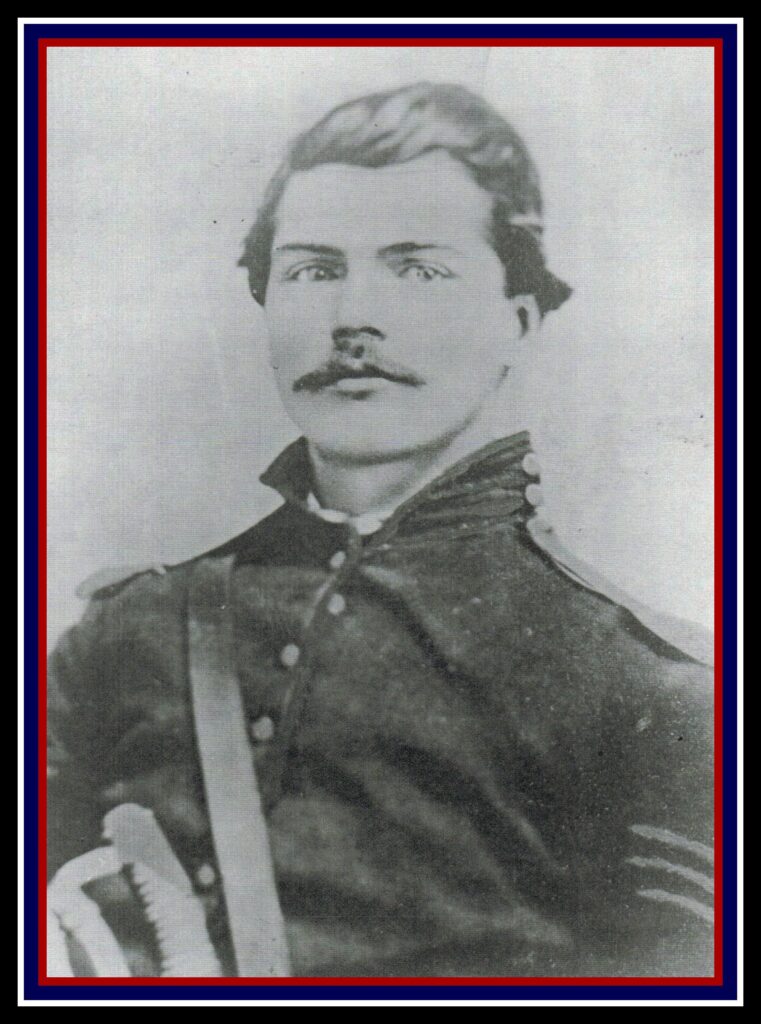
Sgt. Stephen D. Hibler (Find A Grave)
Stephen served in Company M of the 10th Missouri Cavalry.. He entered the service as a commissary sergeant, an essential position responsible for receiving food supplies from depots, ensuring their security during transportation, and distributing rations equitably to all soldiers in the unit.
Hibler’s records note that he participated in several Civil War battles. The 10th Missouri Cavalry was subordinated to Colonel Edward F. Winslow’s Cavalry Brigade during the first four months of 1864. During this time, Winslow’s Cavalry, belonging to the 17th Army Corps, District of Vicksburg, largely engaged in operations in northern Mississippi. Indeed, during the four months in which the 10th Missouri Cavalry served under Winslow, the Colonel’s brigade was fighting in the Union Army’s Meridian campaign, which began in early February.2 The campaign was General William T. Sherman’s first “raid,” or what famed Civil War historian Shelby Foote called “a practice operation” for his later “March to the Sea” through Georgia.3
While Sherman would occupy Meridian by the middle of February, Hibler would not participate in the victory. He was captured in operations near the 1863 Champion Hill battlefield, about 25 miles west of Jackson, near the town of Edwards, Mississippi. Champion Hill was the site of one of Grant’s largest victories in his Vicksburg campaign the year prior. While no details could be found, Hibler was captured here on February 4, 1864, during the very beginning of Sherman’s campaign.
Following his capture, Hibler was taken to the notorious Andersonville prisoner of war camp. He died about eight months later on the first of October 1864, due to “privations at Andersonville.”4Hibler was buried in Andersonville National Cemetery, likely one of the thousands of U.S. soldiers whose fate at Andersonville was recorded by Dorence Atwater and later reported to his family by Clara Barton.
About the Author
Derek Mallett operates “Leadership, Legacy, and Landmarks LLC,” a DC-area tour company focusing on leader development using historic sites. He is the author of Hitler’s Generals in America: Nazi POWs and American Military Intelligence and the editor of Monumental Conflicts: 20th Century Wars and the Evolution of Public Memory.
Sources
[1] Civil War Prisons, “Hibler, Stephen D.” http://www.civilwarprisoners.com/searchresults.php?fname=Stephen&lname=Hibler®iment=&database=andersonville [Accessed 17 May 2026]; Find A Grave, “SGT Stephen Decatur Hibler.” https://www.findagrave.com/memorial/172710476/stephen_decatur-hibler [Accessed: 18 May 2026].
[2] National Park Service, The Civil War, Battle Unit Details: Union Illinois Volunteers, 4th Regiment, Illinois Cavalry. https://www.nps.gov/civilwar/search-battle-units-detail.htm?battleUnitCode=UIL0004RC [Accessed: 17 May 2026].
[3] Kevin Dougherty, “Sherman’s Meridian Campaign: A Practice Run for the March to the Sea,” Mississippi History Now, April 2007. https://www.mshistorynow.mdah.ms.gov/issue/shermans-meridian-campaign-a-practice-run-for-the-march-to-the-sea [Accessed: 17 May 2026].
[4] Civil War Prisons, “Hibler, Stephen D”; Find A Grave, “SGT Stephen Decatur Hibler.”
Posted in: Uncategorized