Clara Barton and “Her Boys” of the Grand Army of the Republic
The Grand Army of the Republic (G.A.R.) hasn’t had a living member since 1956. At the corner of 7th Street and Pennsylvania Avenue, blocks from the Missing Soldiers Office Museum, a lonely old obelisk has stood tall since 1909. Today, the organization that the memorial honors is mostly forgotten. A lingering handful of old buildings and monuments like the obelisk scattered across the country are all that remains. In Clara Barton’s lifetime, the G.A.R. was one of the most powerful groups in the country. To Clara, over the years the increasingly graying members always remained “her boys.” These men knew how she aided their side during the war. Some had even been her patients. To them, she was the Angel of the Battlefield and always welcomed as a friend.

The Stephenson Grand Army of the Republic Memorial (Photo by APK)
The G.A.R. was founded in 1866 by Dr. Benjamin F. Stephenson who saw the need for a fraternal order for veterans. Many men who had returned from the war felt isolated and misunderstood. There were also thousands of war widows and orphans who needed help. The group helped form veteran identity in the post-Civil War United States.
Members gathered in groups by community called posts. They elected officers, adopted bylaws, and wore uniforms. They The men marched in parades and attended public gatherings, always in uniform dress and with their old military discipline was on display. They sang the old songs from the war along with new ones about their service. Gatherings of multiple posts, called encampments, offered multiple posts a chance to get together.
At its peak in 1890, the G.A.R. had more than 400,000 members. Separate auxiliary groups were formed. Women supporters of the war effort like Clara joined the Woman’s Relief Corps. Sons of Union Veterans and Daughters of Union Veterans were established for children of members. The G.A.R. was structured around local posts. These posts would maintain a physical space that would serve as a communal gathering point. Posts were named after living and dead heroes of the war. On June 10, 1881, Clara wrote Post Commander Maj. Seth Hedges after learning the Dansville, NY post was choosing her as their namesake:
Your communication, written at the request of your comrades, to inform me of the establishment of a Post of the G.A.R. in Dansville and that it has been named in honor of me, is a source of gratification beyond my power to express.
Happily, it is no longer necessary for me to define my position with our veteran soldiers, nor the Grand Army of the Republic. They know that my highest respect and my deepest devotion are theirs,- that I with them, as in the days of old, and that the most kindly honor they can bestow upon me, is to permit me to remain so, to recognize me as a comrade who shared their perils, their hardships, and their dangers, and would now share their confidence, and live a little in their memories.
Will you, Major, kindly bear to the members of Barton Post such grateful appreciation of the honor conferred upon me as I am able to communicate with you, and assure them that henceforth, they are my comrades, as I am theirs.

Three G.A.R. Members (Library of Congress)
The G.A.R. had a finite pool of members. Every year as they aged, the number of eligible members decreased. The G.A.R. continued to offer assistance for veterans, widows, and orphans as Benjamin Stephenson envisioned. Hosting lecturers to speak about the war was one of their most popular social events. Clara would often be booked by G.A.R. posts as a speaker. Lecturing was an important source of income for her.
Participating in politics is where they derived power. G.A.R. members were one of the most desired voting blocks. They lobbied heavily. Through acts of Congress, they scored major victories on veteran pensions and veteran federal hiring preference. Politicians knew if they did not support G.A.R. initiatives, they’d face the wrath of G.A.R. voters. Clara was an ally of the G.A.R. When she needed help, they would lend her a hand. Their lobbying helped secure the treaty that created the American Red Cross ratified by Congress.
When Clara died in 1912, the Charles Devens G.A.R. Post contributed an altar draped in black and ornamented by red roses for her funeral service. G.A.R. flags were placed on either side of the stage. Dozens of members were in attendance. Nationwide, from Massachusetts to California, the entire organization grieved her loss. The Woman’s Relief Corp distributed a poem to its members by Reverend P.H. Epler:
Where carnage was reddest
Clara Barton was seen,
And all eyes were uplifted
As it were to a queen
Comrades, attention!
Salute her once more!
Untitled – unchevron,
But dear, as of yore!
About the Author
Roy Blumenfeld is a history enthusiast and volunteer docent at the Clara Barton Missing Soldiers Office Museum. He holds a BS in Political Science from Appalachian State University.
Sources
Websites
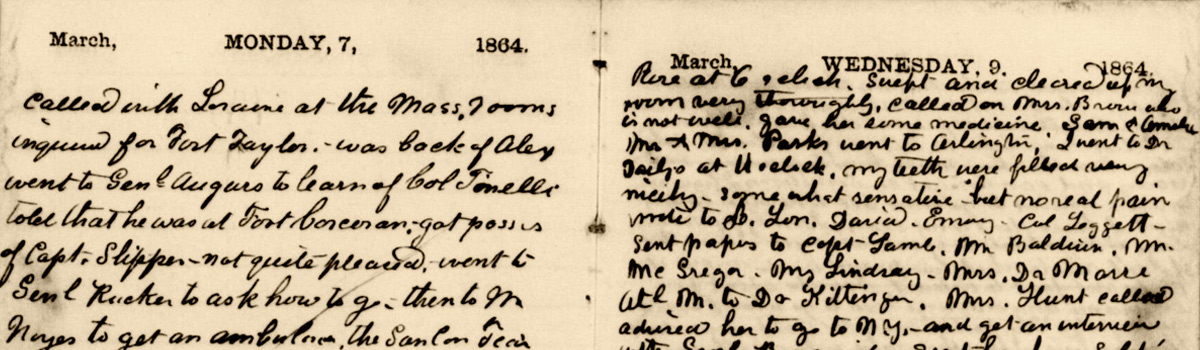
- “Clara Barton Papers: Diaries and Journals, 1849-1911.” Library of Congress, https://www.loc.gov/resource/mss11973.064_0008_0017/?sp=3&st=image&r=0.074,0.394,0.325,0.512,0
- Waskie, Anthony. “The Grand Army of the Republic.” Essential Civil War Curriculum, n.d., https://www.essentialcivilwarcurriculum.com/the-grand-army-of-the-republic.html
Books
- Pryor, Elizabeth Brown. Clara Barton: Professional Angel. University of Pennsylvania Press, 1987.
- Anonymous. Clara Barton: In Memoriam, Memorial Addresses and Funeral Tributes. N.A. Pearson Publishing. 1912.